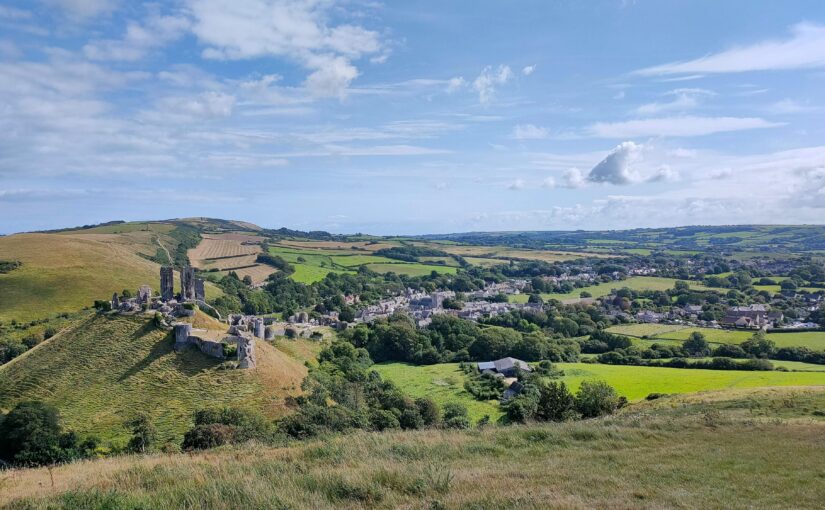
In deepest Dorset with Thomas Hardy

by Jonathan Lorie

The red carpet has been rolled out and the actors are strolling in. At the cinema door they pause for photos beside posters of Carey Mulligan and Martin Sheen. From the far end of the Georgian street you can hear the bleating of sheep. 

Welcome to the Dorset premiere of Far From The Madding Crowd, held in the small town of Bridport as a thankyou for the hundreds of local people who acted as extras or helped as assistants when this latest film of the great novel by Thomas Hardy was shot nearby. To their delight, the film’s producer Andrew Macdonald announces from the stage: ‘Dorset is the star of this film along with Carey and the other actors.’ 

As well as enjoying the film, I’ve come to Dorset to explore the world that inspired this tale. Few writers are as steeped in their landscape as Hardy, and much of his modern appeal lies in his evocation of traditional rural life. In Far From The Madding Crowd he revived an ancient Saxon name for this area – Wessex – and the name has stuck. He called it ‘a partly real, partly dream country’ and I have come to find it.

Bridport itself is a handsome market town whose red-brick streets still bustle with stalls on a Saturday like today. Hardy set his poignant love story Fellow Townsmen here, renaming it Port Bredy, with final scenes in the 500-year-old Bull Hotel. These days the Bull is a boutique hotel with a superb restaurant, but it retains the feel of the grandest coaching inn in town – all bare floorboards, flickering fires and roaring bars, with a rococo ballroom complete with chandeliers. No wonder the Crowd actors stayed here while filming.

I drive north from Bridport to Toller Down, where Hardy’s novel starts. It’s a pretty drive among steep hills and hidden farms to a vast downland 800 feet high and swept by keen winds. This is Hardy’s ‘Norcombe Hill’, where the humble farmer Gabriel Oak first proposes to the wonderfully headstrong Bathsheba Everdene. Here he loses his flock of sheep over a cliff edge and with them his hopes of prosperity and a wife. Today it certainly feels like a wild enough place for calamity.

Below the ridge is the lush valley of the river Frome, and at its source the unchanged village of Evershot. This is deepest Dorset, with Tudor cottages of amber stone and a village shop with an old bow window. Hardy liked to drink by the inglenook hearth at the sixteenth-century Acorn Inn, which he called The Sow And Acorn in his stories: today its elegant four-poster bedrooms are named after his places and characters. Almost next door is Tess Cottage, a white thatched cabin fronted with bluebells, where Hardy’s doomed heroine stopped to rest in Tess Of The d’Urbervilles. 

Then I drive down the valley to Dorchester – ‘Casterbridge’ in Hardy’s tales, a county town of fading Georgian grandeur. It’s built along a road so straight it can only be Roman: roots around here run deep. At the end of the high street, a statue of Hardy sits brooding over the town.  On the flint face of the Barclays Bank, a plaque explains that the Mayor of Casterbridge lived there. The Victorian gothic Corn Exchange is where Bathsheba amazed the male farmers by daring to sell her wheat by herself. Next door is the Dorset Museum, which houses the original furnishings from Thomas Hardy’s study.

Wandering inside, I am astonished. Here’s the leather-topped desk where Hardy wrote, scattered with dip pens. There’s a leather satchel with his drawing instruments, from the early days when he worked as an architect restoring local churches. Beside the mantelpiece is the fiddle that he played at village parties as a boy. 

The study was transferred intact from Hardy’s house on the edge of town, Max Gate. I head there next. It’s a dull red-brick mansion with turrets at each corner and a croquet lawn in front. He designed it himself in the 1880s, the years of his literary success. Beside the hedge stands a shepherd’s hut on wheels, just like Gabriel’s. The drawing room has chintz chairs beside a vast dark fireplace. The dining room has heavy chairs and flame-coloured walls. In the attic is a separate suite of rooms that his first wife Emma moved into halfway through their marriage. This does not feel like a happy home.

And it wasn’t. Here Hardy welcomed the luminaries of late Victorian and Edwardian society, lionised by them as the guardian of an ancient spirit of rural England. But the marriage turned sour and there were rumours of an affair with his cousin. Locals still talk of a pregnancy with a milkmaid. For all his creation of powerful female characters, Hardy himself was not a good husband. His later poetry, written after Emma’s death, is shot through with grief and regret. That is, of course, its greatness.

I drive two miles out of town, to the other, simpler end of Hardy’s life story. In the hamlet of Lower Bockhampton is a yellow stone building surrounded by flowers. It is the village school that he attended as a child, where the alluring outsider Fancy Day came to teach in Under The Greenwood Tree. Was she, perhaps, modelled on his teacher? Did he, perhaps, always have a sense of a world beyond these woods? 

Along the lane I find the old village pump with its crank handle, now disused. And opposite is my hotel for tonight, Yalbury Cottage. It’s named after Yalbury Wood, where the fictional Fancy’s father Geoffrey the gamekeeper lived, and this was house once a shepherd’s home. Today its 300-year-old brick walls and shaggy thatch hide an exquisite small hotel where an oak-beamed restaurant serves local food with a cosmopolitan twist. I think Hardy might have approved.

Next morning I chug up the lane to Higher Bockhampton. Here he was born in 1840, in a simple cottage below Thorncombe Wood. His family were local stonemasons and builders and they used their front yard to store timber and the limestone that makes Dorset villages shine like gold.

I approach the cottage through the wood, where paths have been laid through the landscape of his childhood, past sighing beech trees, sinister sink-holes, a winding Roman road and an eerie pond on a hill where a wild white pony stands and stares at me, whinnying. All these things Hardy captured in the lyrical poems that he wrote throughout his life. His first recorded poem, Domicilium, describes this house and its surroundings.

Beyond the wood is the wilderness of Black Heath, a bleak stretch of gorse and stone and stunted trees. This was Hardy’s prototype for the terrifying wasteland of Egdon Heath, which engulfs his characters in The Return Of The Native. Even today you can feel the power of the landscape to define whole lives. 

I wander back to the serene world of Hardy’s boyhood home. It’s a solid cottage of timeworn brick and thatch, with tiny leaded windows and roses over the door. Inside there are simple rooms with whitewashed walls and bare stone floors. The parlour has a tall wooden settle warmed by a smoking hearth, a mantlepiece displaying two white china dogs, and an old wooden dresser that’s filled with willow pattern plates. In Hardy’s day this room was used for family parties and the country dances which he wrote about so lovingly. Perhaps it was here that he first heard the fiddle and yearned to play it himself.

Upstairs are three small bedrooms – one for the parents, one for the girls and one for the boys. The latter was Hardys into his twenties. It holds a brass bed and a tiny whitewashed table, replica of the one at which Thomas wrote his first four books. He sat in this room, staring out of this small window, dreaming of other lives and possibilities. The breakthrough novel, which allowed him to leave home, marry Emma and abandon local building for the life of a writer, was Far From The Madding Crowd.

I turn back for Dorchester and a final link to the man himself. This afternoon a local amateur dramatic society, the New Hardy Players, are in rehearsal. They’re preparing a stage version of The Return of the Native, to be shown on the lawn of the house at Max Gate. 

Hardy himself loved the stage and in 1908 allowed a local group to call themselves the Hardy Players. One of their number was a baker’s daughter from Dorchester, Norrie Woodhall, whose mother was said to be the original for Tess of the d’Urbervilles. Norrie acted under Hardy’s direction at Max Gate, as a teenager in the 1920s. She remembered him as a kindly and amusing man who was rather taken with her sister who played Tess. When he died in 1928 the group disbanded. But in 2005, for Norrie’s 100th birthday, she asked that the group be revived. It performs to this day, raising money for local charities and for the purchase of  a collection of Hardy’s manuscripts by the Dorset county museum. 

Norrie was the last person to have known the great author, but she died in 2011. Instead I ask the New Players’ director, Howard Payton, how it feels to perform Hardy in his own home town. 

Howard smiles through his white beard. “It’s very powerful to perform Hardy at Max Gate. Out on that lawn, you’re standing under the window of his study. You only have to look up and you think – he’s there.

“And do you know what?” Howard grins. “When I proposed to Alison, I used the words of Gabriel Oak. But Alison gave me a better answer than Bathsheba gave to him.”
On the trail of Frank Lloyd Wright

“All of this was open prairie when Frank Lloyd Wright moved here in 1889,” says George, gazing at the rustling trees and Victorian villas of Oak Park, one of the leafiest suburbs in Chicago. “Back then his children played among dirt tracks and farms. So the houses he designed here were called the Prairie School. And they changed the face of America.”

We’re standing in the backyard of the Frank Lloyd Wright Home and Studio, the first house designed by the man who would become America’s most famous architect. And it’s buzzing with visitors, because this year marks the 150th anniversary of his birth – a moment to be celebrated with events at his houses, exhibitions in Chicago and New York, and a new Wright Trail across 200 miles of his beloved mid-West. So I’ve come here to see what the fuss is all about.

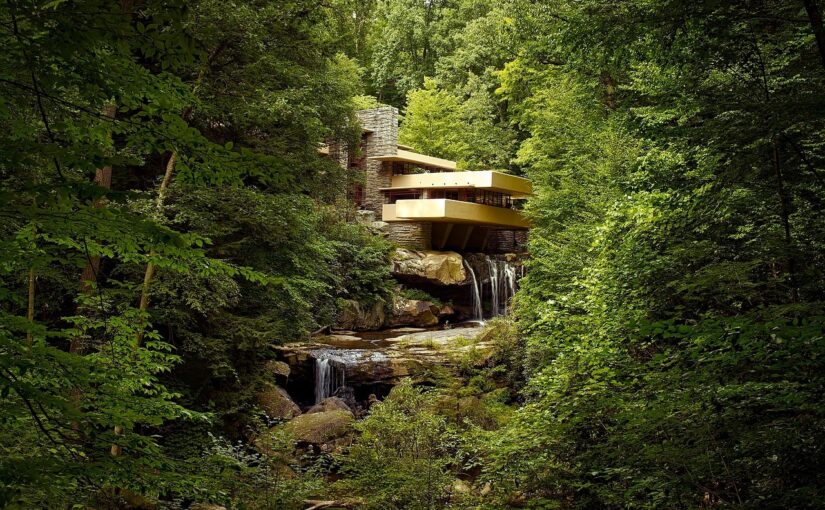
Oak Park isn’t his most famous neighbourhood. That would be Manhattan’s Upper East Side, where his Guggenheim Museum swirls an outrageous snail shell of concrete above the city streets, or Bear Run Stream in Pennsylvania, where his Fallingwater house floats like a beaver dam across a waterfall in the woods. To visit those places is to understand Wright’s extraordinary range and inventiveness as an architect, and his vision of ultra-modern buildings based on natural shapes and local landscapes. But here in Oak Park is where his story begins, and this area holds the greatest concentration of his buildings in the world. 

“Wright built this place as a young man for his wife and children,” explains George, a tour guide at the Home, “but it already has the elements of his Prairie style.” We wander around a house that’s astonishing for 1889. Outside it might be clad in wooden shingles like a prairie cabin. But inside it’s all mod-cons –open-plan living rooms, geometric furniture, wraparound windows and a fitted wooden kitchen. It’s clearly been devised for rational, comfortable family living: a new design for a new way of life in a country that felt young. 

I realise with a shock that my own childhood home in England was laid out just like this in 1968: front door hidden sideways in a porch, open-plan ground floor wrapped around a central rough-stone hearth, and sudden double-height rooms beneath swooping ceilings. How many of our homes, I wonder, have been built from Wright’s ideas in the years since his death in 1959?

As I leave, George hands me an audio-guide to the local area. In these few streets you can see some 30 buildings by Wright, commissioned by neighbours and friends in the 1890s and 1900s as his fame began to grow. There are six in his street alone – among them one of the finest Prairie homes, the Arthur Heurtley House of 1902. It’s wonderfully elegant, a low sweep of soft red brick beneath sheltering eaves, with a grand arched doorway and wide bands of Art Nouveau windows. It’s an early example of one of Wright’s guiding ideas: that strong vertical lines in a building anchor it to the ground and integrate it into the surroundings.

I take a lovely stroll in morning sunshine, spotting Wright houses among the family mansions of Oak Park, where children play on clipped lawns and rocking chairs wait on wooden porches. But up on East Avenue is a house where Wright’s local idyll ended. The Edwin Cheney House is a ramshackle bungalow he built for a friend – while falling in love with their wife. 

Faced with social and professional disgrace, in 1909 Wright fled west, with his new love Mamah. He stopped in a remote part of the prairie 200 miles away, where in a quiet river valley his family had once been farmers. It must felt like sanctuary. And there in 1909 he started work on a second ideal home. He named it Taliesin, a Welsh word for ‘shining brow’, because it sat just under the brow of a sun-kissed hill: and that’s where today’s Wright Trail will lead me.

I clatter from Oak Park into Chicago on the famous elevated railway, known to generations as ‘the L’, and get out near Michigan Avenue. The concrete canyons of America’s second city soar 30 or 50 storeys overhead. It’s a very different vision of architecture from Wright’s natural forms – all steel and glass, corporate power, thrusting machismo. At the far end of Wabash  Avenue I spot a row of giant letters on a heartless glass stump, the second tallest building in the city: they spell in capital letters ‘TRUMP’ and signify the property-developer President’s hotel.

In Wright’s day, this area was being rebuilt after a devastating fire in 1871 had razed the downtown. The building boom gave him his first job as a trainee architect. In the rush, local engineers invented the skyscraper – and the elevator that let you go so high. In fact, the first plate-glass covered skyscraper in the world was the Reliance Building on West Washington Street, built by the elevator magnate William Hale, and that’s where I’m heading for lunch. 

Finished in 1895, the ground floor of this Art Nouveau skyscraper is now an elegant modern restaurant, Atwood, where I am due to meet Todd Palmer, Executive Director of the Chicago Architecture Biennial. He runs a city-wide festival of architecture, open to the public as well as the trade, which opens this year in September. “Architecture has always mattered in Chicago,” he says. “When you have no limits, here’s what you can do. A building can be a mile high, just like a black guy can be President. In fact, Barack Obama has just announced that he’s building his Presidential Library here, to regenerate the South Side. He used to talk about the audacity of hope: this will be the audacity of architecture.”

A great way to see the architecture – and audacity – of Chicago is to catch a boat tour down the Chicago River run by the Chicago Architecture Foundation. I catch it near the 1913 Wylie Tower, a riot of faux Renaissance buttresses and curlicues, and float through the city and its history right through the business district, where modern mirrored blocks perch on slender bases. At the end is America’s tallest building, the Willis Tower of 1974, whose 110 floors are topped with a viewing platform that overlooks four American states. Then we chug back to the dock, where a vast Apple store is being built beside the renovated waterfront. “It’s by Norman Foster,” says the boat guide. “The horizontal canopy of the roof is a nod to the Prairie Style, of which we have so much in Chicago.”

Closer to Frank Lloyd Wright’s era is my hotel, the classic Palmer House of 1873. Walking up the grand marble stair to the central lobby, I sense the opulence and optimism of those days, when Chicago boasted the world’s biggest meatyards, busiest railway and largest post office, when this was the boom-town gateway to the Great Lakes and the American West, and when America was creating its modern self and emerging as the world’s greatest economy. 

That’s what paid for the architecture. And this is where the new rich came – to the hotel’s chandeliered bar with its soaring columns and frescoed ceiling, and its ballroom lined with satin swags and glittering mirrors. This was known as the Gilded Age and the gold is all around me.

I wander out for dinner at another icon of the era, the Chicago Athletic Association. This Victorian Gothic skyscraper of 1893 has recently been converted into a fabulously preppy hang-out with wood-panelled saloons, a frat-like snooker bar and the Cherry Circle Room. I’m heading for the latter, a mellow eaterie that has won the James Beard Award, America’s top culinary prize. Inside it’s all leather banquettes and Art Deco lights, with a soft jazz soundtrack and a fine line in Chateaubriand steaks. I tuck in.

Next morning I set out on the Wright Trail, in a hire car along the dazzling shore of Lake Michigan. Lake Shore Drive has marinas on one side and glittering condos on the other. I pause at the Emil Bach House in Rogers Park, a 1915 Wright house where you can stay. It’s a modest Art Deco-style place with all the hallmarks of Wright: open-plan living and dining rooms, circling around a rough-cast central hearth and lit by horizontal bands of windows. From the garden there’s a glimpse of the lake just a block away.

Then it’s onto the Interstate highway, dodging unfeasibly large cargo trucks which all seem to be painted red. I head for Racine, a once-industrial town just across the state line in Wisconsin. Here Wright built what he hoped would be an ideal blueprint for industry: the Johnson wax company’s headquarters. “The finest office building in the world,” was how he described it, “as inspiring a place to work in as any cathedral ever was to worship in.” 

Even today, the place is visionary. I walk in past rippling pools to a low brick building lit by massive windows, where a lofty open-plan workspace is furnished with ergonomic steel desks and chairs. Fifty tapering columns that look like giant lily stems support a vast glass ceiling to let in more light. It was the first building in the USA to have air conditioning. This is a different vision for corporate existence from today’s harsh geometry back in Chicago. And here, as long ago as 1939, Wright set standards for working conditions that have hardly been bettered.  Today it’s still used by 300 lucky office staff.

But most of the industry has gone from Racine, and as I drive the backstreets I see sagging clapboard houses and rusty cars in what once were neat neighbourhoods. The glory days have long gone, and in November’s election Wisconsin swung from Democrat to Republican. As I cruise on, I see an isolated landscape of scattered farmlands and wooden villages, wreckage from another era floating on the rich black earth of the open prairie. The gilded age has clearly passed.

I chug on to Milwaukee, where in a shabby suburb Wright once built his vision of affordable housing for all. “Welcome to the American System Built Houses,” smiles Mike Lilek, trustee of the Wright In Wisconsin charity, showing me around a row of six modest houses on West Burnham Street. 

“To enjoy a Wright house you have to walk through it,” he says. “This one has 33 windows, to connect you to the outdoors. It has serene colours. Mr Wright said ‘For your colours, go to the woods, not to the store.’ He believed in connecting with nature.” Mike grins. “Sixty per cent of the people I take around here say ‘I could live here.’ 

“Wright spent more time on this project than any other, because he thought these could be mass-produced cheaply and built all over the country. He thought ordinary people should have an architect-designed home. And he wanted to design something American, fiercely American, something you could say ‘This is ours.’ “

The houses are modest but well proportioned, with an Art Deco serenity and plenty of windows. Some are still being refurbished, and Mike asks me what is the strange white surface on the exterior of the walls. He can’t find anyone in the States to repair it. “Pebbledash,” I smile, “must have been one of his experiments.” 

I thank Mike and head further west, following the Wright Trail signposts to Madison, the capital of Wisconsin. It’s a handsome town between lakes and woods, with a neo-classical capitol on the hill as you drive in. Wright was brought up here in the 1870s, 40 years after it was the frontier of the West. In the 1940s he gave back, with a church for the faith of his fathers in a style that echoes those prairie pioneers. The Unitarian Meeting House has a roof that rises like the canopy of a covered waggon, and a base shaped like the blades of a plough cutting into the lawn around it. 

I park and go inside. It’s like the tardis – a low-ceilinged entrance and then a

spectacular chapel, soaring from the low lobby to a 60-foot high roof, walled with sheer glass, a spectacular space for worship where worshippers look straight into sunlight and nature, which Wright saw as symbols of the divine.

Rather less divine was the 20-year struggle Wright had with local politicians to approve plans for his other great Madison building, the Monona Terrace. It was never built in his lifetime, but one of his trainees, Antony Puttnam, completed it in 1997. Today it sits on the shore of pretty Lake Monona, a low curve of white concrete hiding dramatic public spaces for concerts, conventions and parties. The walls are hung with 1950s photos of the master himself, taken by his official photographer Pedro Guerrero. It’s good to finally catch a glimpse of the man. Here he is in his trademark Western hat and suit, talking with trainees and clients. His face is handsome and thoughtful, but lined with the cares of three marriages and constant money worries.

To get a stronger sense of him, I trundle on to Taliesin, the house among hills that he built and rebuilt from 1911 for the rest of his life. It sits in the wonderfully named Driftless Valley, a lovely region of ridges and forests where deer leap onto the road beside my car. True to Wright’s naturalistic beliefs, the house is a low complex of roofs and balconies just below the brow of a hill, slipped into the landscape. Here he gathered a community of students and collaborators, founded an architecture school that still runs, and rebuilt the village school for his teacher aunts. Taliesin became his kingdom and laboratory, continually modified and expanded as he tried out new ideas that fed into his masterworks. And these days it’s open to the public.

I’m taken around by Ryan Hewson, who trained here as an architect and now works as a curator. “Learning here was wonderful,” he says as we peek into the architecture school with its drawing boards and monastic bedrooms. “This place was his sketchbook, where he could push ideas as far as he liked. But we were lucky – in Mr Wright’s day students had to work on the farm and help build the house as well.”

The house is equally wondrous: a maze of dreamy rooms with wide windows looking onto forests, fields and the Wisconsin River. It’s hung with a fabulous collection of Japanese prints, which Wright collected and dealt in. The Japanese influence on his work is evident in the post-and-beam construction of his studio, and in fact he had worked in Tokyo on a hotel project in the 1910s. 

In the old drafting room I meet the last of Wright’s original community. Antony Puttnam is a white-haired architect who trained with Wright and completed the Monona Terrace after his mentor’s death. He says hello in a slow, mid-Western drawl and tells me how he came here. 

“In 1953 I walked into the living room here as a curious student and thought – this is the place.” He muses as though still surprised. “It effects a lot of people like that. Just last Spring I took some architects around and half of them wept. So I asked Mr Wright if I could stay. 

“His standard was – if it isn’t beautiful, don’t do it. He was witty and charming, very light on his feet when talking to people, but determined. He expected things. Some of the work here was a little improvised, but it’s still standing. He was always changing and experimenting with ideas. The house was almost a maquette for seeing what could be done. It’s a statement of alternate reality.”

Wright set his alternate reality in a place he had discovered as a boy. The Driftless Valley was settled by his Welsh immigrant family in 1858, and he was sent as a teenager to spend summers on his uncle’s farm. “The valley taught me everything,” he said, and his love of nature and landscape started there. 

From his final living room in Taliesin, you can see their old farm across the valley. I drive over. Just below a hill is the Aldebaran farmhouse of 1861, shingled like Oak Park and sheltered by deep roofs. Inside there’s a rough central fireplace circled with living rooms. The big windows look onto grass and trees. These things became Wright hallmarks. Were they really aesthetics or memories? Was this the original Prairie House? I stand on the porch and stare from his childhood to his future across a meadow of softly waving grass and understand why he came home. 

Just across the country road from the farm I see the spire of a chapel. It’s the Wright family resting-place and the first building he ever worked on. As a young unknown, his family offered him work on designing the roof. I walk through the rusty gate. 

The chapel is a square of American Gothic, wood-shingled walls and a simple spire, in a copse of trees beside a stream. It’s like stepping back into the frontier days, before the boom and bust of what America became. Around it under yew trees lie the graves of generations of his ancestors, back to 1870. 

Here are his mother and the teacher aunts, the farming uncle, and his lover Mamah. And then in a circle of pebbles is his own grave from 1959, topped with a boulder of granite. Beside him are his children, many of his collaborators, and the photographer Pedro Guerrero. 

In this cradle of the settler generation, I sense Frank Lloyd Wright’s life spanning the years of American greatness, reaching from them into the future with all his optimism and patriotism, his belief in community and nature. And I wonder whether we shall see giants like him again. 

As I turn to leave, an eagle soars into the prairie sky.

In Rembrandt’s Amsterdam

by Jonathan Lorie

“It’s like getting to know Rembrandt as a friend,” whispers Celeste as she smears black ink across the fine lines of the copper plate. “People come here and watch me making these prints and sometimes they start to cry.”

Autumn light falls through a tiny leaded window into the room where the great painter once worked. Celeste smiles. “I think it’s because he put so much emotion into his pictures.” 

She lays the plate on an ancient wooden printing press and cranks a wheel beside it. The copper bites into a sheet of thick creamy paper. When she peels them apart, I am staring at a wispy portrait of a middle-aged woman with curly hair and patient eyes. It is Saskia, the painter’s wife, in the second year of her marriage, smiling quietly at the viewer. The print is signed and dated 1636.

We are standing in the Rembrandt House Museum in Amsterdam, which is the actual house where Saskia and Rembrandt lived in the heyday of his fame as a painter in the Golden Age of the Dutch Republic. I have come here to explore his life and his world, as a major exhibition of his work opens at the National Gallery in London. And you don’t get any closer to the great man than wandering the seventeenth-century rooms of his own home.

I am shown around by the curator, Dr David de Witt. The rooms have been furnished in exact period style, based on details from Rembrandt’s pictures and a list of his possessions. On the ground floor at the front is a grand room where he displayed and sold paintings to clients. At the back is a simple kitchen with blue Delft tiles and a box bed for a servant. On the first floor is a large studio – the bare boards that he paced while painting, the windows that flooded his easel with northern light. 

On the attic floor above, David sits me at a table and unwraps a tissue-covered parcel. Inside is a 10-inch square of copper. “This is an original,” he murmurs, “a plate etched by Rembrandt himself. We have six of them. The ones we use downstairs are casts from real ones like this.” Out of the old metal gazes the face of Saskia, the original of the print that Celeste just made.

I thank David and wander out, dazzled by the house and the afternoon sunshine. Down the street is another Rembrandt landmark – De Waag, a turreted medieval gatehouse where he painted his first great commission, The Anatomy Lesson of Dr Nicolaes Tulp. The old medical lecture hall is still there, up a winding stair, but today its wooden doors are closed to the public. So I retire downstairs, to a tiny bar whose ceilings are hung with wooden beams and chandeliers, and order a glass of the historic Amsterdam drink, Jenever. 

This was the spirit carried in the ships of the Dutch East India Company, as they traded in spices and silks from the Far East to Europe – a trade that created the glittering wealth of Holland’s Golden Age. ‘Jenever’ gave rise to our drink ‘gin’, both based on juniper berries. “But the English is a poor copy,” the barman grins, as he pours out thimbles of firewater. One is called ‘Rembrandt’ and its label carries a spindly print of an artist in a tricorn hat and cloak, drawing in front of a windmill. The taste is dark and heavy. It would keep you warm on a cargo ship pitching through the Java Sea.

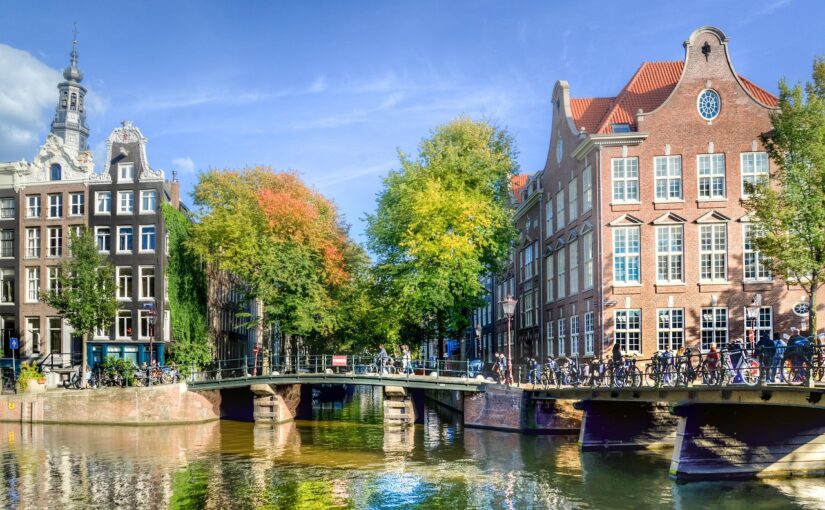
Several glasses later I lurch outside and head for the safety of my hotel. The Waldorf Astoria is the newest and possibly smartest hotel in town, an elegant conflation of six grand mansions on a seventeenth-century canal. These canals were built in Rembrandt’s lifetime to organise the city as a major trading capital with goods coming in by boat. Today Amsterdam’s inner rings of canals are a graceful sweep of urban civility, edged on one side by tall brick townhouses with red or green window shutters, and on the other by quiet waters where houseboats are moored beside bicycles. The Dutch pattern for urban living, in narrow terraced houses with gardens behind, spread to London during a century that ended with a Dutch king on the English throne. 

The Waldorf is suitably historic inside. There’s a grand wooden staircase beneath white plaster scrollwork, marble floors leading to tall windows, and at the rear a garden with clipped lawns and a baroque summerhouse. My suite is in the loft, a vast space that would once have stored merchants’ goods. 

I head downstairs to the Michelin-starred restaurant, where for dinner I struggle manfully through course after course of astonishing inventions. Exquisite confections are served on polished rocks or gleaming driftwood, frothing with foams, dripping with jus, entirely unrecognisable but definitely delicious. The Golden Age had nothing on this.

The best place in the world to see Rembrandts is the Rijksmuseum, and this is where I head next morning. Newly reopened after a 10-year refurbishment, it’s a lovely airy space now, where pride of place is given to the Golden Age artists. A wall of Vermeers portrays the everyday life in houses like Rembrandt’s, and some glorious Pieter de Hoochs show Amsterdam at the time – the newly built canals glimpsed from the homes of newly wealthy merchants. At the far end is Rembrandt’s grandest painting, The Night Watch, a dramatic commission from a city militia. 

More interesting, for me, is a room of early Rembrandt oils, from the time when he was finding his style. It includes one of the first of the series of self-portraits that he made throughout his life and which tell his story as it showed in his face. Here the 22-year-old hopeful peers out from a mop of curly hair, his cheeks as yet unlined.

The life of Rembrandt van Rijn is one of the great dramas of European art. Born the son of a miller in 1606 in the newly independent Dutch Republic, he studied painting from the age of 14 and by his twenties was successful enough to move to Amsterdam and marry the cousin of his art dealer. But Saskia came from a grander family, none of whom attended the wedding. Later they claimed she was wasting her inheritance. Yet the happy couple prospered as his style became the height of fashion and wealthy townsfolk commissioned the series of portraits for which he is famous – luminous portrayals of character and spirit, increasingly perceptive as time went on, yet always compassionate. In his heyday, his self-portraits show a man in his prime, richly dressed and confident. 

But his art went out of vogue and Saskia succumbed to – probably – tuberculosis. He drew her on her deathbed, heartbreaking sketches of loss. Three children had already died within weeks of their birth. He lost his savings on a trading venture that went wrong and had to sell the house. Declared bankrupt, he lost his license to sell paintings. In his later years, poor and obscure, he sold paintings through a front company set up by his son Titus. Then Titus died too. After Saskia, he had two relationships – both with servants – but one sued him for breach of promise and the other, Hendrickje, died in a year of plague. 

Yet Rembrandt continued to paint and his latest works are the greatest: dark, brooding, loose-brushed, raw-emotioned, as though he no longer had time for the fineries of life and only sought the deeper truths of human experience. The final self-portraits show him aging magnificently.

And in these years, he was visited by one last great patron. The Grand Duke of Tuscany, a Medici prince on a European tour, took the trouble to visit him at home not once but twice. Cosimo de’ Medici is thought to have taken back with him to Italy one of those self-portraits, in a final act of homage.

I wander out of the Rijksmuseum, through a street of art galleries, to the area where Rembrandt lived in his twilight years. His last home no longer stands but it was in the Jordaan, a modest district that is quieter than the grand canals. Its brick-paved streets are host to traditional cafes, its cobbles are filled with bikes, and there’s a heron perched on the roof of a houseboat where I will stay tonight. Here I will be close to the water that brought the wealth into this city. I step onto the deck. Down a ladder there is one single cabin, a long room of polished planks and brass, its windows filled with glints of green water. 

Next day beside the mooring I find the Tulip Museum, an intriguing place that houses an exhibition on the tulip mania that swept Holland in Rembrandt’s day. This was an investment bubble in then exotic flowers, when a single bulb could be worth as much as a townhouse, and it reflected the city’s wealth and style. Even today, Holland is famous for its flowers. Downstairs there’s a copy of a painting by Rembrandt: a tender portrait of Saskia, painted in the year of their marriage, with tulips in her hair.

Just across the canal from here is the Westerkerk, a handsome baroque church of weathered brick. There Rembrandt was buried in 1669, in a pauper’s grave whose whereabouts we do not know. Titus had died the year before and was buried here too, which may have broken his heart. On a pillar inside the church there’s a simple memorial plaque to the great painter, copied from a sign in his masterwork The Night Watch. 

My final stop, for a little light relief, is the Five Flies. It’s a restaurant that is a monument to his era. If you want to step inside those boisterous paintings of Golden Age townsfolk enjoying a mighty fine meal, then this is the place. Its tiny, historic rooms are lined with Delft tiles and gilded leather, lit by carved fireplaces and flickering chandeliers, and served by an army of discreet waiters. The chairs carry brass plaques for celebrities who have eaten here, from Orson Welles to Jean Cocteau, Gary Cooper to Mick Jagger.

There is, of course, a Rembrandt Room. Its ceiling is dark with wooden beams, its walls are lined with shelves of leather-bound books. I slump into a seat, ready to be revived. And as the waiter pours a glass of chilled white wine, he points to the wall above my head. There, in an antique frame, is an etching that I recognise. He says it is an original. Nearly four centuries ago it was printed in that little house across this lovely city, from the copper plate now kept in the attic archive. It is Rembrandt’s portrait of Saskia, full of the love and promise of their youth. 

I raise a glass to them both.

Away with the fairies

by Jonathan Lorie

Puss in Boots strides towards me, a handsome fellow with a walrus moustache and a rapier on his belt. Next comes Red Riding Hood, a blond girl with pigtails and clogs that tap on the floorboards of the stage. Behind her slinks The Wolf, his eyes dark, his haunches quivering with power and desire.

Jasmine the puppeteer looks up from her marionettes. “I like the Cinderella puppet best,” she smiles, “she is so beautiful. But at night, you know, it’s scary in here. If you’re rehearsing, there are shadows in the corners. Things creak.”

She unhooks the wolf and folds him away, laying him down in the box where he lives. Then she whispers in his ear: “Good night.”

We are standing backstage at the puppet theatre in Steinau, central Germany. It’s the town where, two centuries ago, the Brothers Grimm grew up and heard their first fairytales – actually old folk stories – which they would spend their lives collecting, transcribing and publishing for everyone to read. Along the way, they changed the culture of childhood forever. From their work we get Snow White, Hansel and Gretel, Rapunzel and many other favourites that continue to inspire books and movies to this day.

Steinau today could be a setting for their tales, its streets cobbled, its houses half-timbered, its square complete with a stone fountain carved with fairytale figures: a witch beside a cottage in a wood, a prince climbing up the gilded tresses of a girl in a castle, an ugly little man dancing around a fire. And I have come here, with my two children, to enter a shared world of fables.

Steinau is the start of a waymarked Fairytale Route through the province of Hesse. It follows the places where Jacob and Wilhelm Grimm lived and where their tales were found. Our journey starts here, at their childhood home, a half timbered manor house where they grew up in the 1790s. Now a sort of shrine to them, it displays information about their early lives, and in its garden is a life-size statue of Hansel trapped inside a wooden cage. That was always my favourite tale. My daughter, aged 11, pokes a stick through the bars to see if Hansel is fat enough to eat. My son, 12, shakes an apple out of the twisting tree above: luckily it is not poisoned.

I scoop up the kids and drive them off to a farmhouse in a forest. The Brathahnchen Farm Hotel lies up a narrow track in a spiky wood. Its ground floor is a series of low tavern rooms, their rough white walls lit by lanterns hung from blackened beams, their wooden benches softened with raw sheep’s fleeces. A huge fireplace crackles at one end, where spits of meat turn and smoke. It’s the kind of place where stories might be told on a winter’s night: or where a scullery maid might sweep cinders from a hearth and earn herself a nickname. We sit down for supper at a long trestle table shared with local countryfolk.

Next morning we drive north through the rich farmlands of Hesse to the picturesque town of Alsfeld, to visit a museum of fairytales. The town is a tangle of sixteenth-century lanes, filled with the sound of cathedral bells clanging. Somewhere in the maze we find the Marchenhaus, its white walls and brown timbers looking like icing sugar and gingerbread. In front is a well with a stone frog perched on its rim, wearing a golden crown and waiting to be kissed. We tiptoe in through a dark wooden door etched with the date ‘1618’.

The rooms of this museum are decorated with life-size tableaux from the tales. Statues of Hansel and Gretel creep up to a cottage where an old woman leers by an oven door. Rumpelstiltskin weaves gold thread from sweet-smelling bales of straw. A witch’s kitchen features a black cat and a row of herbs above an iron stove. A real-life storyteller in a green cloak emerges from a corner and stares at us. “I am a herb woman,” she whispers. “I grow them in my garden. Stories come from them.”

My children are thrilled and also terrified, a response you would expect from the best of these tales. Often criticised as too strong for young readers, they were increasingly sanitised by the Grimms in their series of books from 1812 to 1857. But the core of horror remains, offering stories in which children and other innocents are put at mortal risk by evil adults – but resist and triumph thanks to goodness, loyalty and, quite often, sheer cunning. There is sex, murder, cannibalism and crime in these stories, the dangers of the adult world and the possibility of a small person surviving them.

We slip away from the herbalist and head for the safety of Snow White’s cottage. It’s an hour’s drive away, across gentle hills and woods, in a village called Bergfreiheit. The white-washed cottage fails to impress my son, who announces that it’s a fake. But my daughter is amused by its seven bunk beds, the seven chairs around its wooden kitchen table, and the photo we take of ourselves in emerald-coloured dwarvish hoods. I am not quite transported to childhood by this costume.

But on the edge of the village is a piece of real folklore. The Kupferbergwerk Mine is all that’s left of an industry that may explain the seven dwarves of the tale. The wooded hillside here is riddled with copper mines from the sixteenth century and the low tunnels were often worked by children, whose short stature gained them a local nickname: ‘dwarves’.

You can go inside a disused shaft from 1552, with a hard hat and a guide. Wooden pitprops frame rough walls as you descend its long dark tunnel. “This is copper,” says the guide, pointing at a smear of green, “and this is Fool’s Gold,” by a wall of glittering crystals.

Miners here were given special freedoms, and the village became a haven for outlaws and runaways. Bergfreiheit means ‘freedom hill’. It’s the perfect setting for a tale of escape and transformation, like Snow White’s escape from the evil Queen. 

But there is more. A display at the cottage suggests that the model for Snow White was Margarethe of Waldeck, the beautiful daughter of a local count, who fled from a jealous stepmother and died in 1554 – of poisoning. Her brother owned these copper mines. Sometime around that time, a scandal spread of a father who had poisoned his children with bad apples.

This may be how the folktales emerged, from histories and gossip and local scares, retold through generations and slowly merging together.

Margarethe’s castle of Waldeck is nearby, and that is where we will stay tonight. These days it’s an elegant hotel, a far cry from the humble village. Its towers and battlements rise above a glittering lake, and we enter through a gothic hall. This would have been a world of princes and kings, who fairytale figures might tame through marriage or success, but who also oppress them, as in the stories of Snow White or Cinderella. Interestingly, the heroes of the tales are seldom grand: more often they are woodcutters, peasants, fishermen, and their actions convey the survival skills of ordinary folk.

Next day we descend to the castle dungeons. “Creepy or what?” says my daughter with a thrill of fear. Among the stone vaults is a torture chamber, a grisly reminder of the real world of power surrounding the tales. There’s a whipping bench and an executioner’s block, a woodcut map of noble estates dated 1575, and a hand-drawn family tree showing several Margarethes. I wonder which one she was.   

To get a firmer grip on the history, we drive north to the city of Kassel, where the Grimm brothers moved from Steinau in 1798. They seem always to have lived and worked close to each other, sharing interests and ambitions. Here they worked as librarians and published their first book of ‘Kinder- und Hausmärchen’ (Tales For Children And Households) in 1812.

It was a time of upheaval. Napoleon had occupied and then abandoned this area, leaving behind revolutionary ideas about national identity and the power of the people. These would coalesce in the brothers’ work, with its search for the soul of a people through their stories and its wish to identify a common German identity.

Their historic mission is described in Kassel’s Grimmwelt, a modern museum of pale stone and elegant displays commemorating their lives. We wander through it, past manuscripts and portraits and first editions of their books, the children slightly bored by so much history. Then we head to the edge of town, looking for a building that the brothers knew: the Brauhaus Knallhutte, an eighteenth-century roadside inn where Jacob and Wilhelm gathered stories. More than 40 came from the innkeeper’s daughter, Dorothea Viehmann, who had heard them from passing travellers.

The tavern is still a roadside place – next to a ring road, behind a car park, on an industrial estate. But we persevere and inside it is a delight. There’s a brass bar, a long dining room with dark beams and red banquettes, and soft light falling through stained glass windows of huntsmen and barmaids. We order sausages and munch them contentedly.

Our final stop may or may not have a Grimm connection. But if it doesn’t, it should. Sababurg claims to be Sleeping Beauty’s castle, and its pepperpot towers from 1334 are surrounded by magnificent beech woods – some of Europe’s largest – which would deter all but the boldest knights. Inside its ruined great hall there is a rough wooden stage where we watch the daily performance of Sleeping Beauty. At the end, a prince in red velvet wins a pretty maiden, her blond hair woven with pink roses.

Walking onto the battlements, I spot a herd of door on the slope below, like the strangely met animals of myths. Then we unlock a little door at the foot of a tower and clamber up a spiral stair. On a landing sits a spinning wheel. At the top are our rooms for the night, each with a four-poster bed. For the castle has been transformed into a wildly romantic hotel. Our lancet windows are edged with climbing roses, in case a prince might want to visit.

But that night, as we hop into the great carved beds, the children are spooked by the ruins and the moonlight. We have stepped too far into the imaginative power of the tales. It’s a long night, with every creak of ancient floorboards a fright for them. To keep out the dark I read them the tales, where every ordeal leads to a happy ending.

In the bright light of next morning, we walk around the castle grounds, which claim to be Europe’s oldest zoological gardens, dating from 1571. Herds of deer, musk ox and wild boar are roaming free. In a remote enclosure we spot a creature that haunts the tales, as once he haunted the untamed woods of Europe: a wolf. He stares at us. His eyes are black and burning. He is the fear we meet in fairy stories – and learn to overcome.

Driving away from the castle, I stop the car in an endless stand of fir trees. The kids tumble out to explore. They giggle and shout, free at last. There are wild blackberries among long grass, pine needles on raw earth, and rows of trees stretching away forever. We all seem tiny in this place. The branches are crooked fingers, clutching out at us. We are children among dark powers. Once these forests stretched across all of northern Europe and Asia, and they figure still – in fairytales, in Shakespeare, in Hollywood movies – as a place of challenge and of change.

Then my daughter picks a blackberry and my son lobs a pine cone at me, and we are innocents once more, protected by the joy of our journey and the wisdom of what we have seen.

Travel writing in strange times

by Jonathan Lorie

It’s always a pleasure to judge the Bradt New Travel Writer of the Year award, the UK’s leading prize for new and unpublished travel writers – partly for the quality of entries, partly for the jousting between judges and partly for what it tells us about the state of the genre and sometimes the state of the world.

This year was no exception. The expert panel gathered, five lifelong fans of travel writing: Amy Sohanpaul from Wexas Traveller magazine, Hilary Bradt, Adrian Philips and Hugh Brune from Bradt Guides, and myself. In front of us was a longlist of 15 travel stories on the theme of ‘A Hasty Exit’. Entertainingly they ranged from getting lost in the Gobi Desert to getting marooned off a Scottish island, Cold War memories  in Belgrade and archaeological theft in Bolivia. 

The genre is clearly in healthy form, though dealing with new realities. In most of these stories, a feeling of danger was ever-present and this may be a clue to our present state of mind. Here were tales of sinister encounters with strangers, falling ill in foreign places, risks of Covid or extortion or physical assault. To judge by these writings, we have entered an age of anxiety. 

After much debate we agreed a shortlist of four stories, more than usual because they were so well written. How to describe them? Three were as above, shot through with unease, ending with redemption but only after darkness. The fourth offered more hope.

Jacqui Hatt’s entry, A Vital Warning Ignored, was a gripping tale of danger and rescue on a train in Serbia featuring two types of strangers – the ones that help you and the ones that really don’t. 

Rebecca Legros wrote A Dance with Duende, a dazzling story of a mugging overcome by a lone woman in the backstreets of Spain, written in the format of a flamenco dance. 

Sarah Davies’s The Birds of Auschwitz was a sensitively handled encounter with a place of profound evil in Poland, ending with a reflection on what it means today for those who visit.

Julie Adjour’s Later or Sooner was written like a folktale, recalling a map to the world’s most beautiful place, sketched on a napkin by a stranger in her youth but never followed since.

And perhaps that’s where we’re at today, as the world turns on its axis and old certainties go up in smoke: stuck between shadows and promises, searching for the kindness of strangers.

Tonight we will announce who won this year’s award, at a glittering ceremony in Stanford’s bookshop in Covent Garden. The grandees of travel publishing will be there. They may be pleased to learn that two of our shortlisted entries were written in experimental form, always a sign that writers are grappling with how stories can capture things, can structure and tame and maybe even redeem the realities we experience. 

Whether hope will triumph over danger tonight, you’ll have to wait and see.

Shortlisted entries can be read on the Bradt website, where you can also sign up for alerts about next year’s award.

Seeking Dr Livingstone

by Jonathan Lorie

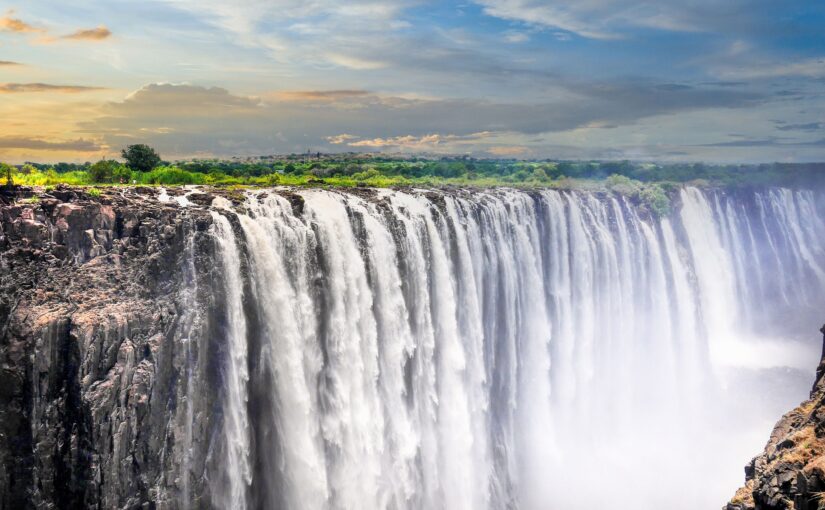
Nine million litres of angry river race past my ankles and roar over the cliff. The lip of the world’s greatest waterfall is twenty feet away. I inch a little deeper. Frothing currents rip at my legs as my toes search for a grip. Spray rises a thousand feet in the air. A single slip and I’m gone.

“There is where we swim,” says my guide Eustace, pointing at a circle of black water surrounded by raging surf that’s on the very edge. “There is safe.”  

Welcome to the Victoria Falls, adrenaline centre of Africa. Some come here to bungee from the bridge, microlight above the spray, or raft the whitewater that explodes from the gorge three hundred feet below. But I’ve come in search of an older adventurer – the explorer David Livingstone, born 200 years ago, who named these Falls for his Queen. And where better to start than Livingstone Island, perched above his greatest discovery, where I’m about to defy both gravity and sanity by swimming in the Angel’s Pool. 

Eustace holds out a hand and I grab it gladly. Together we teeter along a submerged ridge of stones towards a ragged boulder. I scramble over and down the other side, plunging waist-deep into dark water – then deeper – then my feet find a hold and I’m up to my neck but standing firm. I turn around to look. 

On every side a torrent of jagged water surges towards the lip. We are five feet from the drop. But the Pool is calm. I stare across the rim of the Falls, where a thousand miles of the Zambezi’s flow are tumbling into space. 

I duck my head under water, like a baptism in this wild place, then bob up and grin at Eustace. He throws me a thumbs up. Then we clamber back to the island and safety and lunch.

‘Scenes so lovely must have been gazed upon by angels in their flight,’ is how Livingstone described the Falls. And it was from this island that he was the first European to see them, in 1855. Padding back through the reeds, we pass a stone monument to him. Eustace pauses. “Dr Livingstone was very important for us here in Zambia. He opened up this part of Africa for the outside world, for Christianity, and for the fight against the slave trade.” 

Livingstone left the island by dugout canoe, but we have Captain Viny and his motorboat – a steel dart that spins a terrifying line parallel to the mile-wide rim and then back up the swirling river. Ten minutes upstream, Viny moors us in smoother waters beside the clipped lawns of the Royal Livingstone Hotel. It’s a splendid white colonial-style place, where zebras wander beneath the trees and tea is served on the verandah. 

I duck into the cool of the long bar where ceiling fans whirr and oil paintings portray worthies of Britain’s imperial era. On the wall is a period map of Livingstone’s travels around the Zambezi. It shows lots of blank spaces where nothing was known, and one or two of his geographical errors. A tiny line of type identifies the publisher as ‘Stanfords Geographical Establishment, Charing Cross, London’. Stanfords supplied maps to Livingstone and Cecil Rhodes, and is still the world’s best travel bookshop.

Charming as it is, this colonial stuff was never here in Livingstone’s day. When he tramped through, this was raw bush with a populace ravaged by Arab slavers. The Tonga tribe used the island to sacrifice goats to the gods of the Falls. Colonisation was the remedy the Doctor prescribed for such ills, to bring Christianity and legitimate commerce. We might query such views today, but within 10 years of his death in 1873, the first British settlers had arrived. 

Looking for their ghosts, I catch a car into the nearest town – Livingstone, named after the great man, and once the capital of the British protectorate of Northern Rhodesia. It’s a delightfully sleepy place, its main roads lined with stuccoed colonial buildings and gaggles of teenagers. There’s a Stanley House, named after the explorer who found Dr Livingstone starving in the bush, and a David Livingstone Presbyterian Church, and a fast-food joint called the Hungry Lion. But the highlight for me is the town’s museum, which houses a unique collection of his personal possessions.

It’s an odd sensation to stand in front of a glass case that holds the battered white medicine chest with which Dr Livingstone treated the malaria and dysentery that plagued his 30 years of trekking through south-central Africa. Or another that has the flintlock musket that subdued wild animals, hostile tribes and mutinous porters. Here’s his field notebook, open where he has sketched the Falls in navy blue, the spray rising in grey above. There’s a copy of Pilgrim’s Progress, translated into Sechuana for the only convert he ever made, a Bakwain chief called Sechele. 

Even closer to the man, here is his wife’s own copy of his first published book, Missionary Travels – the memoir that made him a hero to Victorian England, though Mary was to die of malaria on one of his later expeditions. And there, in front of me, is his hat – the famous blue kepi with its band of gold. Finally, by the door, is a black tin trunk whose lid is stained with blobs of black wax, where every night he fixed a candle to write up his journal. The trunk was by his bed on the morning in the swamps when his African servants found him, hours dead but kneeling in prayer. 

Astonishingly, they wrapped the Doctor’s body in tree bark and carried it over 1,000 miles to the coast, where a British warship took it home. But his heart was left in Africa, buried beneath a mpundu tree at the request of the local chief. A piece of the tree is here in the museum.

I drive slowly back to my hotel. Livingstone came here to explore the Zambezi, hoping it would offer a navigable waterway to the heart of Africa. But he was defeated by its rapids. In the end it was trains not boats that opened up the region, starting with Cecil Rhodes’ railway from Cape Town to the great iron bridge that he built at the Falls. By 1904, just 30 years after Livingstone’s death, Thomas Cook was running train trips for tourists to this frontier of empire.

The ultimate in tourism today are the luxury lodges along the banks of the Zambezi. And I am staying in one of the loveliest: Tongabezi. It’s a scattering of glorified African rondavels – round huts with thatched roofs – among tall trees by the water. Inside they are luxurious. Mine has wide windows onto a vast bend of the river, crisp beds under frilly nets, and a claw-foot bath with a view to die for. At night hippos grunt in the shallows as I eat dinner on a raft on the river, the white linen and rare-grilled steak lit only by glittering candles and stars overhead.

It’s a far cry from Livingstone’s experiences. To get closer to his era, I head up-country next day. A rattling 12-seat Cessna flies me to Mfue, gateway to one of Africa’s finest game parks, South Luangwa. We soar above endless tracts of forest without roads or towns, marked only by the brown snakes of big rivers. Driving from the tiny airstrip to the park, I pass fields of maize plants and banana palms, between villages of mud and thatch where families gather in beaten-earth yards and mothers cook over open fires. How much out here has changed?

“David Livingstone crossed the Luangwa River just north of here,” says Adrian Carr, stabbing a finger at the map that spills from his first edition of The Last Journals Of David Livingstone. We’re sitting in his house on the edge of the park and he’s showing me a book from 1874. On its red cover is a gold illustration of porters carrying the Doctor across a swamp. “I know that place. There aren’t any roads up there, but local people still use it to cross the river.”

He pauses, a big, soft-spoken man in khaki shorts and shirt who has spent a lifetime guiding and hunting out here. “You know, life hasn’t changed a lot up there. Sure, they have some schooling, but they still grow what they eat. They still believe in the old gods. 

“Can you imagine what it was like when Livingstone came through? The only white man for a thousand miles? He must have been so tough.”

Toughness is a virtue still valued by men like Adrian, one of the last of the great white hunters who made African safaris famous. His father, Norman Carr, invented the walking safari, back in the 1950s, and opened up Zambia for tourism. Black and white photos of the old man grace the walls of Adrian’s game lodge nearby, where I will be staying tonight. They mostly show Norman with two tame lions at his side.

I drive into Kapani Lodge through a gateway roofed with reeds. On the road I have already seen three elephants at a pond. The lodge is built like a colonial estate, or perhaps the kind of mission station that Livingstone dreamed of founding. Its handsome cottages of ochre and thatch face a lake where hippos snort among flowers. Gazelles graze the banks. An open-walled drawing room has horns on the wall and skins on the floor.

I check in my bags and meet my guide, Shadreck Nkhoma, a burly man with a ready smile. We hop in his jeep and roar off to the park. On a bridge across the Luangwa River there are baboons on patrol and a 15 foot crocodile in the water. The park itself is a lovely rolling landscape of tall green grasses and spiky mopane woodlands. A cloud of impalas drift down a slope to a water hole where zebras swish their tails. In a grove of thorn trees, four giraffes stretch up to feed. This is Africa before the modern world. In the distance I hear the coughing of lions.

Rounding a bend, we catch a flash of yellow in a tree. Shadreck hits the brakes. The yellow has black spots. I raise my binoculars and stare into the eyes of a young male leopard. He flexes his paws and glances away. 

“My family lived here before it was a park,” says Shadreck as we drive off towards a sunset spot on the banks of the wide river. I ask how far the sense of history goes out here. “I know back to my great-grandfather,” he muses. “His family came from Batoka, towards the Falls. They came to this side of the river and lived the old way – in round mud houses with roofs made of grass, hunting and fishing.” The sunset is a blaze of purple and gold. “Then the park came and they moved out to the village.” 

The village is Mfue, and next morning I ask Shadreck to show me around. We wander through the wooden stalls of the market and the concrete cabins of the hardware stores, and then we see a church. “That’s my church,” he beams and ushers me inside. 

St Agnes Church is a red brick box with glassless windows and a roof of tin. The elders shake my hand with warmth and surprise. “And this is our teacher, Edwin,” says Shadreck with a grin. Edwin Chupa passes me a bible. I cannot understand its words. “This is in our language,” he smiles, and reads aloud the creation of the world in Nyanja. It’s a lilting, soft language, making the ancient words anew for Africa. His voice rolls round the bare brick walls. 

When he stops, I ask what he thinks of the missionaries like David Livingstone who came out here. His old eyes shine. “They brought us the light. They did not know it at the time, but they did. Now we have Christianity, roads, medicines.” He touches my arm. “Because of them, we are standing here now, you and me, understanding one another.”

In Laurie Lee country

by Jonathan Lorie

As I walked out one midsummer morning I found myself in Laurie Lee’s Gloucestershire, a glorious region of rippling valleys, ancient villages and echoes of an older England. This is where the much-loved country writer was born in the final summer of the Edwardian era – June 1914 – and I had come here to find the rural world that he captured so magically in his memoir of childhood, Cider With Rosie.

I started at one of Laurie’s favourite places – Painswick Beacon, a hill so high that from the Iron Age fort on top you can see all the way to Wales. Here Laurie used to come with his schoolboy friends in the 1920s, to marvel at the view. Clambering up its stony ramparts, I reached the summit and simply stood and stared. 

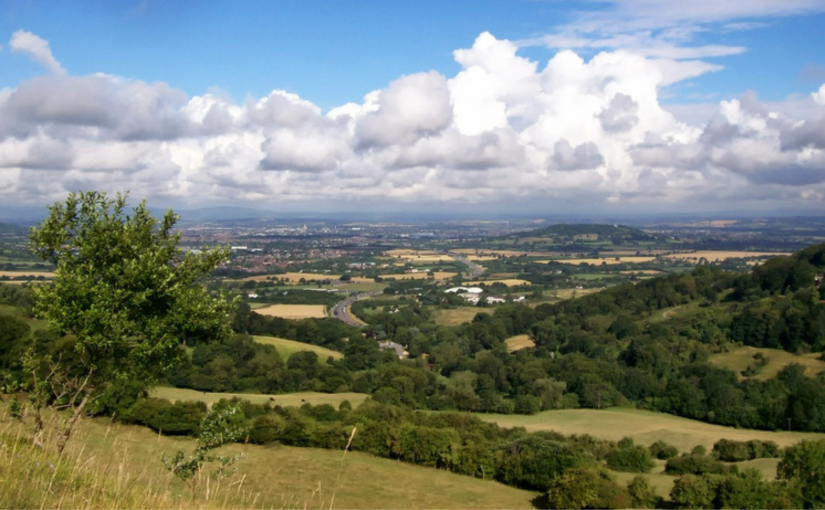
This must be one of the finest vistas in England. For 25 miles I could see, across rolling fields and brimming hedgerows to the blue teeth of the Malvern hills, past the red roofs of Gloucester with its Gothic cathedral poking skywards. To the left shone the pewter coils of the Severn river, and beyond it the faint smudge of the Black Mountains, 40 miles away. To the right was the wooded hill where villagers still roll Double Gloucester cheeses at Whitsun in an ancient and anarchic local custom. And behind me was the first of the crinkled little valleys that Laurie Lee called home.

No wonder he came up here as a boy. No wonder that 25 years after he left the village where he was raised, he caught so powerfully the glory of the English countryside. All of this world was his, preserved for posterity in his memoirs and poems. A childhood spent here would not leave you easily.

I turned and followed the stony path down, through the classic Cotswold village of Painswick where Laurie met his first girlfriend, and across a valley to his home village of Slad. At first I walked the Cotswold Way, then Stepping Stones Lane where hay lay heavy and sweet in the fields, and finally a broken old drover’s track through dark woods and high meadows of orchids and butterflies. A green holloway swept me down to Slad itself – which seemed no more than a hamlet really, a scatter of stone houses strung above a stream. 

There was a war memorial, a church and of course a pub. The Woolpack was a classic village inn, a simple place of scrubbed wood and friendly drinkers, a long narrow room along the side of the hill with windows onto a sweeping view. They served a cider called Old Rosie, and in one corner was the blackened settle where Laurie himself used to sit.

Today his seat was occupied by a younger poet, Adam Horowitz, who grew up in the valley in the 1970s and knew Laurie since then. At that stage Laurie had made a return to the village, after years as a writer in London, enabled by the success of Cider With Rosie to buy a cottage and settle with his wife and daughter back here. He encouraged the young Horowitz to write poetry, even at one stage bribing him with a fiver to “Go and get drunk and write some poetry!”

I ordered a pint and sat beside Adam. “My abiding impression of Laurie,” he said, “is of him standing with his arms outstretched, a big smile on his face, a little tipsy, being roguish and charming.” There was a photo of Laurie above the bar, in just such a pose. “He said it’s difficult to write if you’re living in Slad, because either there’s long grass for lying in the sun, or else there’s someone knocking on your door saying ‘Come to the pub for a chat.’ But at the heart of him, he needed to be here, to reconnect. It was a grounding thing.

“If you’re growing up here as a writer, as I did, the landscape talks back to you.  Walking through it inspires poetry. It’s both safe and wild. The past springs up, in the drystone walls or the shape of the fields. And there’s a continual cycle of death and life, change and decay, a seasonal cycle, as any nature writer will tell you. There’s a certain need for this sort of landscape – and for writing about it.”

We ambled out into bright sunlight and Adam showed me the village. Across the road from the pub lay the old church, with a window dedicated to Laurie in 2011. Outside was his grave, a simple stone inscribed with the words ‘He lies in the valley he loved.’ On its reverse we found some lines from his sweetest poem, April Rise, blessing a day in spring.

Up the lane was a bank of bright flowers leading down to his childhood home – Rosebank – the bleached stone cottage described in Cider With Rosie. In his day it was crowded with seven siblings and cluttered by his eccentric mother Annie. It’s still lived in by a country family, whose harassed mother was bustling around the garden keeping two toddlers from crying in the midday heat. I asked whether she ever thought about Laurie and his family squeezed in there. “Oh no,” she said firmly, “not unless I’ve been watching the films. You don’t live in the past.”

But the past was all around us. Further on was the old squire’s house, a handsome Tudor mansion in stone where Laurie and his friends went carol-singing each winter. Just beyond it was the gloomy pond where a spinster drowned herself, in one of the spookier chapters of his book. “It’s just fading from living memory,” Adam mused. “That’s why I think his work will last.”

The edge of living memory was where I was heading next. I said goodbye to Adam and walked past the pond towards the last cider orchard in the village. Across steep and boggy fields, through a footpath unsigned and overgrown with nettles, lay Furners Farm. I was welcomed into its medieval interior by Julie Cooper, who sat me in the dark kitchen and poured a glass of  her home-made cider.  So this was the stuff that they drank back then. It was cool but fierce, like a softened brandy.

“We met the original Rosie once,” she smiled, “if there was a real Rosie. About 20 years ago they brought her here for a documentary. She’d been a postmistress in Cheltenham. She was in her seventies, she’d been to the school here, and she sat on the swing in our garden. She was very sweet. But she didn’t remember kissing Laurie Lee under a hay wagon.”

She introduced me to her son, a handsome 13-year-old whose name was Laurie. As I turned to go, she whispered: “The kiss with Rosie happened in the second field beyond the stile. Past the old apple trees. Look out for it.”

So I stumbled along there and stood on a field still laid to hay, sweeping down to the stream and the village beyond. Laurie always said there were several Rosies in reality and his book could have been called Cider With Edna or Cider With Doreen. But whatever the truth of it, the setting for his delicious tale could easily have been this patch of earth.

In his essay on Writing Autobiography, Laurie suggested that ‘the only truth is what you remember’. Critics have questioned how much of his famous trilogy of memoirs was really true. Some say the timings cannot be accurate in As I Walked Out One Midsummer Morning, his achingly romantic memoir of walking across Spain as a penniless busker of 19 in 1935. Veterans of the Spanish Civil War query his account of volunteering for the republic, in A Moment Of War. The documentation does not exist to ever really tell. But someone who knows more than most is his daughter, Jessy, who still lives in the village.

I walked back to her cottage. It had whitewashed walls and an inglenook fireplace and a garden bright with flowers. “This was my childhood home,” she said, fixing me with enormous green eyes. She had the soft mouth and easy charm of her father, as though one were meeting him again. “This is where we all lived. It was wonderful being brought up here, playing in the stream, picknicking on Swift’s Hill. We were here together when he died. On a beautiful evening the sky turned totally black and a double rainbow stretched across the valley. It was extraordinary. Afterwards people sent me photos of it.”

She paused and stared into space. “It was awful for mum and I, just after he died, to have these nasty attacks from people saying ‘Was Laurie telling the truth about Spain?’ What’s wonderful is there’s so much more evidence now.”

For Laurie’s centenary in 2014, Jessy published a book of his paintings and drawings, which she had found after his death in 1997, hidden beneath a bed. “The book is a homage, really, to Dad – because I never really thanked him.” She pauses. “He did often seem tormented, which is one of the side effects of great art. But then he wrote wonderful celebratory poems about the landscape. And his prose was a long version of his poetry. I defy anyone not to get something out of his work.”

I thank her and turn to go. As I wander away down the winding lane of the village, I recall one further memory of Laurie. I met him myself, just once, at a reading he gave in London of his poems. It must have been the late 1970s. By then he was in his sixties, but he read the rippling words in a soft and heavy voice with a rich West Country accent, a voice you can hear in the prose of his books.

Afterwards I found him at the bar, nursing a small glass of white wine. Beside him was an untouched tray of tumblers filled with cider. “Aren’t you drinking the cider?” I asked. “Oh no,” he smiled, “I don’t touch it any more. You can get into trouble with that.”

Beside the summer sea

by Jonathan Lorie

“Look out for whales!” yelled my teenage son as our bicycles rattled onto a twisting path above a cliff. Below us green waves licked pebbly coves, behind us red cottages edged fields of corn. We freewheeled down a final slope to a hundred-year-old wooden farmhouse turned gallery, where he found hot chocolate and I found modern art, on a gentle lawn by the summer sea.

If you’ve never been to the Danish Riviera, prepare for a surprise. Not only is it one of Europe’s prettiest coasts, it’s also cool enough for kids, restful enough for their parents and less exorbitant than you’d think. This gentle curve of fishing hamlets and fine beaches runs 80 miles north from Copenhagen to the North Sea – and though locals spend their summers here, the British haven’t yet discovered it. So I took my son and daughter there to explore.

We had started in Copenhagen, possibly Europe’s hippest city with its cutting-edge Scandi style. My son and daughter were wowed by this everywhere – in avant-garde buildings on the waterfront like the glittering Black Diamond library, among sleek clothes and spiky furniture in the designer store Illums Bolighus, and even in our boutique hotel, the minimalist Ibsens on a sidestreet of bookshops. More challenging was the New Nordic cuisine we tried at Vakst, a hipster restaurant whose walls were packed with plant pots and tables filled with pretty but strange-tasting food: salt cod with gooseberries, anyone?

But despite everything that was hip and hyped, my teenagers’ favourite spot in this city was the Tivoli Gardens – an old-fashioned theme park that dates from 1843, since when generations of Danish kids have screamed and laughed on the traditional rollercoaster and the tiny pedal-boats – as did mine. Trends may change but children don’t.

So we drove out along the coast in search of more tradition. Thirty minutes north we found the first of a series of Edwardian seaside villages – Rungsted, where white wooden villas lined a sandy beach and swimmers dived into the sea from creaky wooden jetties. Beyond a marina bobbing with yachts, we found Rungstedlund, a seventeenth-century farmhouse that belonged to one of my heroes, Karen Blixen, the 1930s author of Out Of Africa. We wandered through its neo-classical rooms, with their ornate porcelain stoves and gilded mirrors, to her study hung with African spears. In the museum shop, her great-grandniece was chatting with visitors and planning for her wedding there.

Equally historic was our hotel nearby, Kokkedal Castle, a fairytale chateau of icing-sugar facades and sweeping stairways set among woodlands and croquet lawns. That night a wedding party was in full swing, the guests in black tie or ball gowns wafting through its baroque rooms while we hid in the bar and ate sausages. Next morning a polo party took over the back lawn, while we borrowed bicycles and cycled down to the seashore, singing as we went.

Then it was back into our car for a trip into the future, up the coast to Louisiana, Denmark’s leading museum of modern art. Perched on a cliff among gardens filled with flowers and sculptures, the place is a sprawl of modernist wood-and-glass cubes crammed with thought-provoking art. The kids were delighted to find a four-foot cigarette stub by Claes Oldenburg, and a mirrored room where spotlights were reflected to infinity, as though we were staring into the stars.

At the museum café we sampled smorrebrod – traditional open sandwiches of ham or salmon on dark rye bread – and I warned my daughter that some holiday homework was coming up. For ten miles north lay the castle of Helsingore, better known as Elsinore to students of literature like her. Here Shakespeare set his great tragedy, based on the Viking saga of Amleth. It is even imagined that he may have joined a troupe of English actors who toured here in his youth.

The castle was another baroque fantasy, surrounded by granite battlements and crammed with tapestried rooms lit by glittering chandeliers. In one of Europe’s longest ballrooms we found Hamlet and Ophelia arguing over love letters – or actors playing them as part of the annual Shakespeare festival. The theme continued at our hotel that night, the nineteenth-century Marienlyst, where they checked us into the Ophelia suite. The hotel’s blackened wooden frontage overlooked a tiny beach, and down a grand double stairway we found its restaurant, where fish fresh and salty from the Baltic was served above the waves.

Next day we took a 20-minute detour inland to the vast Lake Esrum, where we hopped into kayaks for a long, slow paddle among islands edged with bullrushes and herons. Dragonflies fluttered past. “I live in a village by the lake,” said our kayak instructor. “In autumn we forage in the woods for mushrooms and raspberries. We like to be close to nature here.”

At dusk we chugged back to the coast, to the furthest village on the Riviera. Gilleleje had a harbour filled with fishing boats and lanes strewn with white cottages. On the stone quayside we ate seafood at a ramshackle café, then pottered along a clifftop path with views across the quiet waters to Sweden, visible as a dove-grey cliff ten miles off. Below us stretched the loveliest, loneliest stretch of beach, empty of people, dotted with boulders smoothed by the sea.

On a high spot among trees we found a rough-hewn monument of granite, with the words ‘Soren Kierkegaard 1813’ carved into its mottled face. The great philosopher liked to walk here, for the solitude and peace to think. In his journal he wrote about this place: ‘I often stood there and reflected on my past life. The force of the sea and the struggle of the elements made me realise how unimportant I was.’

In that remote spot, I understood what he meant. All I could see was waves and gulls and my children.

Judging the Travel Book of the Year Award

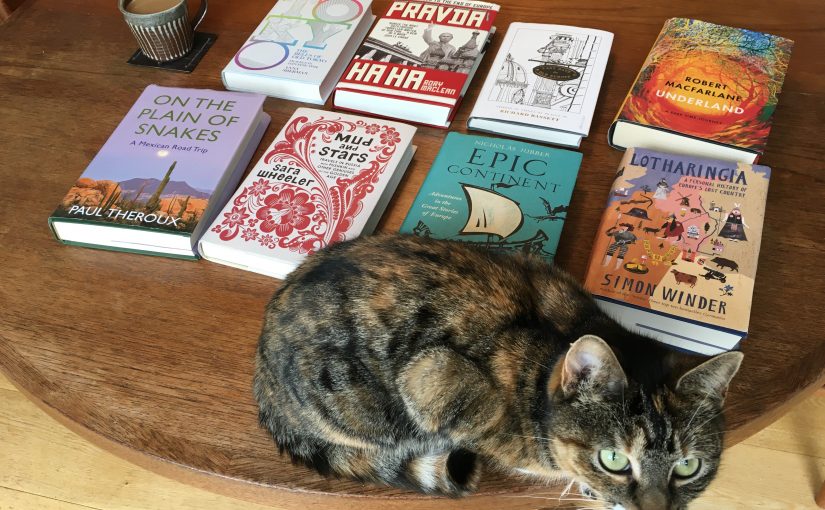
Like Mark Twain, reports of the death of travel writing have been greatly exaggerated. I know this because I’ve spent the winter months reading the best of the past year’s travel books, helped now and then by my cat. 

This is not how most people choose to spend their winter evenings, but I’ve been one of the judges of the Stanford Dolman Travel Book of the Year for 2020. It’s the travel world’s annual accolade for its best book writers, our successor to the legendary Thomas Cook Travel Book Award – among whose winners were many giants of our genre – which I fondly recall judging almost 20 years ago.

What a cast of characters the old Thomas Cook had honoured over the years…. Patrick Leigh Fermor, the only writer I know to have joined a cavalry charge across a castle drawbridge in wartime. Norman Lewis, whose life included spying for Britain, writing the wondrous Voices of the Old Sea, owning a chain of camera stores and living with two women entirely unaware of each other. Then there were dashing English gentlemen like Tim Severin, scintillating heart-throbs like Jason Elliot, Soho bohemians like Jonathan Raban…. The prize judging took place at the Travellers’ Club in Pall Mall, over candlelit dinners on plates decorated with portraits of Lord Byron.

It was a time and a place and a tone. Reports of the death of travel writing have partly been based on the fading of that generation, whose classic style is sometimes described as ‘the white linen suit in the tropics’. That’s an unfair phrase for some of those authors, but reading through this year’s books, it is clear that a sea-change has occurred.

Today the travel books on my coffee table, meekly awaiting judgement, are alive to the modern world and how it is turning. Almost all are reaching across cultures and eras to tell us – and sometimes warn us – about the forces unleashed by our new world disorder. Together they are defining a new territory for travel writing.

In the age of fake news, they offer us the testimony of the traveller, the first-hand report of what is actually going on across our troubled world. As the poet WH Auden once wrote, in ‘a low dishonest decade’ not unlike our own: ‘Consider this and in our time.’

So here are some of the shortlist chosen for this year’s award. Quietest of them all was Richard Bassett’s Last Days in Old Europe, whose title says it all. A gentle memoir of living in places that once were part of the glittering Hapsburg empire, it offered a poignant reminder that superpowers can fall apart.

Also seeking lessons from the past was Simon Winder’s Lotharingia, a history of the borderlands between France and Germany since the days of Charlemagne. Was this a travel book? Who knows, but its overriding point was that centuries of conflicts have started there from politicking and nationalism, culminating in two hideous world wars fought along disputed European borders.

The meaning of borders was explored by Paul Theroux, whose book On the Plain of Snakes saw him driving along the US-Mexican border to judge the realities of the controversial ‘wall’ and the societies on either side. Predictably, he found people less divided than their nations, and developed a heartfelt writer’s credo that the heart of a country lies in its ‘hard-up hinterland’ not its flashy tourist sites. 

Sara Wheeler traversed the hard-up hinterland of Russia in Mud and Stars, searching for the stories of its great and often exiled writers – people such as Pushkin and Chekov – which mainly reminded me that there was a time when Russia was so cultured that it bothered to send its writers to Siberia. That era persisted from the Tsars through the Soviets, but probably ended with the present regime.

The rise of Putin’s Russia was vividly observed by Rory Maclean in Pravda Ha Ha, in meetings with everyone from illegal migrants to obscenely wealthy oligarchs. In a finely written and funny book, he pursues a serious question: why has Russia moved from optimism and democracy at the fall of the Berlin Wall, towards fatalism and dictatorship today? His answer involves national trauma and the comforts of nostalgia, imagined resentments against the outside world, and a widespread willingness to believe in lies. The implications for our own society are clear and somewhat chilling. Maclean’s book was runner-up for the Dolmen Award – and rightly so.

Moving away from the pressures of our day, but circling back to explain them, were two further books well worth a read. 

Epic Continent, by Nicholas Jubber, followed him across the regions spanned by various national myths in Europe – from innocent tales such as the Odyssey in Greece or a Viking saga in Iceland, to stories that have forged influential myths of more questionable kinds: most notably the duplicitous Song of Ronald that fired French patriotism for centuries, and the Rhineland tales of German heroism that inspired Wagner and then the Nazis. The inescapable conclusion is that nations define themselves through myths of a literary kind like these, and also through political myths – or shall we call them lies – about their own greatness, which prompt them towards aggression.

And finally, the winning book was Robert Macfarlane’s Underland, an astonishing work that takes us back to the beginnings of mankind in the rock-art caves of the Dordogne, and forwards to the futuristic mines being built in Finland and America to store our nuclear waste. In between he examines some of the greatest questions – what it means to be human, why we bury our dead, how we treat the world’s resources as riches to be extracted, and ultimately whether we will prove to have been good environmental guardians for the generations that will follow ours. The book may prove to be Macfarlane’s masterpiece. 

All of which is a long way from the elegant dinners in the Travellers’ Club of yore. And perhaps all the better for it. I look forward to next year’s list.

Sailing the Swedish islands

by Jonathan Lorie

“You eat it with a knife and fork,” smiles Jane, my blonde-haired Swedish cousin, as I peer into a bowl of dauntingly named Summer Meadow Soup. Blobs of orange and brown vegetable matter float in a puddle of grey froth, sprinkled with what might be woodshavings. So this is the famous cutting edge of Scandinavian cuisine. I lift half a meadow onto my fork and pray.

We’re dining in Matbaran, a Michelin-starred bistro in the Grand Hotel in Stockholm, across the water from the classical facade of the Royal Palace, in a dark-wood room that’s lit till late by the silver gleam of a midsummer sun. Around us a buzz of smart city folk are crowding the tables, ordering ice-cold beers and wooden trays of avant-garde food. It’s the night before I sail into the choppy waters of the Stockholm archipelago, and I’m catching a last taste of urban sophistication.

The soup tastes fabulous – a midsummer medley of woodland flavours like artichokes and bitter leaves, rooted in a truffle broth. Jane leans across and says: “Where you are going, it is like nothing you have ever seen.” Her blue eyes sparkle. “The archipelago is so beautiful. I want to live out there myself.”

The cluster of islands off eastern Sweden form the biggest archipelago in the world, with more rocks, skerries, islets and habitable chunks than Indonesia or the Canadian arctic. Stockholm itself is the start of a chain of 28,945 of them, stretching 60 kilometres towards the open waters of the Baltic Sea. That’s where I’m heading in the morning, following the track of the midnight sun.

The morning dawns clear. Before the boat leaves, there’s just time to explore the Grand Hotel where I’m staying. It’s the only 5-star hotel in Sweden – and deserves those stars. For its elegant neo-classical rooms are where the Nobel Prize winners stay each winter, and where the first Nobel awards banquets were held, in a fairytale salon modelled on Versailles, glittering with mirrors and gold panelling. 

I wander through a series of gorgeous rococo rooms leading out of the Hall of Mirrors, and downstairs I find a complete contrast: the uber-modern Nordic Spa – a shrine to the art of sauna, with a swimming pool lit by flaming torches and a jacuzzi built like a foaming rock pool. This is Scandinavian culture on an epic scale. Should there be some Vikings?

But I’m heading for simpler pleasures, and I trip across the quay outside the Grand to the landing stage for a ferry to the islands. As I walk up the gangway I notice that this is a working boat: on its deck are bundles of timber and roofing felt, bound for the isles. 

A toot of the whistle and off we go, thundering past the seventeenth-century alleys of the old town, then a cluster of warehouses, and quickly out to a landscape that is a seascape: rocky islets dense with pines, and hidden among the trees the first of the wooden summer houses – a rust-red cabin with white shutters, a sea-green bungalow with a red roof, a shell-white bathing hut on a boulder above the water, then a stone-grey villa with white carved balconies. Motor boats zip past, bouncing off waves. Yachts race at full sail. Swans glide on the swell. 

We pause at a tiny island where a girl in blue dungarees ambles down a granite jetty to greet her sister off the boat. A man pushes a wheelbarrow of logs across a lawn by the sea, where a table and chairs wait under a silver birch. It’s another world, and another pace of life.

My first stop is at Grinda, a large island two hours’ sail into the middle archipelago. The ferry clangs against the jetty, and I am met by Lars Sunekvist, a big man with a bigger smile, who chucks my bag into the back of a dusty golf truck and takes me on a bumpy ride towards the island’s only hotel. We putter through rippling woods where he says there are roe deer and foxes. Red chalets sprinkle lush meadows that sweep down to the sea, where rugged boulders break the surf. 

Lars shouts over the engine, “I brought up my kids on this island for two years. It gives them a different perspective. They don’t have 24/7 shopping, but it is so peaceful. We just spent time together.”

As are many families playing outside their cottages or tumbling in the water. “The whole island is owned by Stockholm city council,” says Lars, “so you can roam everywhere and the cabins are for rent to anyone. It’s not like other islands.”

He drops me at my room, in a wooden house with bleached floorboards but an iphone sound dock. I head straight downhill and find a tiny harbour full of yachts, where a trio of blond-haired dudes in shades are running a kayak shack. 

I ask if I can hire one. They hand me a paddle and a life vest. I explain that I haven’t really done this for a long time and should I have an instructor? They look at me and at the sea. One drawls, “Well, it doesn’t look like rain. You’ll be OK. Here’s a map.”

On the pebbly shore I twiddle my legs into a slender kayak and the dudes shove me off. I wonder how to hold the double-ended paddle. I look straight ahead and take a deep breath and pull. Magically the craft moves forwards. Its hull is orange against deep green water.

I paddle out of the sheltered bay and along the edges of the island, out of sight of people and houses, along a waterway fringed by dark trees and pink roses and jagged granite. A seagull soars overhead. The world is silent except for the splash of my blades. 

In a wider channel dotted with islands I stop and let the kayak drift, silent, staring at the milky sky of midsummer and the rolling water. It’s just me and the sea. I wonder whether my Swedish ancestors paddled or rowed around here, among fjords or islands like this, in the millenia before petrol engines.

My grandfather came from Stockholm and I was brought up on family tales of pre-war summers that lasted forever, among tall trees and sparkling lakes. But I never saw it for myself before.

Up until the 1950s these islands were home to 3,000 people, fishing and hunting from water-bound villages. The narrow twisting channels guarded the approaches to Stockholm, too, and Grinda has had a sailors’ inn since 1777. Its ruins can be seen near the ferry dock. Today that inn has been replaced by a fine old hotel, the Wardshus – and that’s where I’ve promised myself dinner tonight.

The Wardshus is a gem of Arts and Crafts architecture, all cream stucco and steep roofs, built in 1906 by the architect of Stockholm’s Grand Hotel. The owner here was Henrik Santesson, first head of the Nobel Foundation, and he brought his family to spend their summers in the heyday of Swedish grand society. Their idyllic holidays are captured forever in photos on the dining room walls: toddlers, servants, fishermen, patriarchs – another world again.

Tonight it’s too hot to eat indoors, despite the hotel’s fine interior like a Carl Larsen painting, all wooden panels and curving stairs and a big log fire beneath elk’s horns. I need fresh air, and where better than the garden terrace, with its trailing silver birches and its view across the pewter waters to island after island after island.

The outdoor tables are filled with healthy-looking yachting folk, and I order a seafood special: Arctic chard dressed with bright green roe, huge mussels that taste of the sea, slivers of apple and fennel. The delicate flavours of fish are lightened by the bright fruit flavours and a sprinkling of aromatic dill. I’m lightened too, by a glass of chilled Sancerre. Finally the midsummer sun sets, setting a trail of golden shimmers from white sky to grey shore. Sometimes I wonder why my grandfather left.

Next morning I take a change of pace, on board a big ferryboat packed with holiday-makers headed for Sandhamn – the smartest, busiest of the islands. It’s an hour further out towards the outer archipelago. Half way there I tap on the captain’s door and am allowed into the bridge, where grey-bearded Nils Gunnar is sitting among the flashing lights and levers that guide the ship. He’s been a ship’s captain for 40 years and lives on the boat for a week at a time. “I live in the archipelago,” he smiles. “This job, it’s alright.” At a steady 25 knots, he brings us into harbour.

After the quiet of Grinda, Sandhamn feels crowded. It’s only a wooden village built round a small marina, but there’s a hot dog kiosk selling Le Monde, a deli offering baskets of crusty oysters and scarlet lobsters, and shirtless boys on yachts flirting with languid girls in Hollister t-shirts. Blue and white boats nod at anchor and blond children in orange life-vests skip along the sandy streets.

I’m here to meet one of the few fisherman remaining in the archipelago, Anders Naslund. I’m told his house is “behind the bakery”. I wander into the backstreets. They’re a jumble of white picket fences and wooden cottages painted rust red, pistachio green or mustard yellow, among fruit trees and grass paths. When I find it, the bakery is a red cabin surrounded by white flowers, and beside it is a path blocked by a weather-beaten oar. That must be the place.

I walk past the oar and down a curve of path between clouds of marguerites and poppies. There’s a brown house by green water and a yellow-haired man in blue oilskins. A knife dangles from his braces. Anders. He smiles, a twinkling smile in a sea-creased face, and we sit beside the shore and talk. 

He tells me of growing up on the island, when there were only seven families here, and piloting the cargo boats, and his fish trap that takes three days to build every spring, and the biggest fish he ever caught – a 22-kilo salmon as tall as his shoulders. 

Then he shows me where he smokes the fish, in an outdoor cupboard that creaks open to reveal blackened walls, treacly from years of smoke and fish oil. He holds up a handful of pine branches and explains that these give a special flavour. Beside them is a tree stump with an axe buried to the hilt. 

He doesn’t have any fish on the go just now, so I seek out lunch at the Sandhamn Yacht Hotel. It’s another fine Arts and Crafts building, its restaurant a spectacular barn of a room lit with ships’ lanterns above the marina. Their speciality is a dish of three types of herring, the best one sluiced in vodka and succulent with vanilla and lingonberry sauce. 

This hotel was originally the headquarters of the Royal Swedish Yacht Club, and still houses a pine-panelled clubroom and the harbourmaster’s office. The young harbourmaster, Paul Henriz, shows me around and tells me about a race last week, the biggest of the year, which broke records for its speed. “It took only three days,” he smiles. His office is crammed with flags from every nation, “in case a visiting team might win.”

I wander outside to meet two more locals: Adam Svensson, a long-haired skipper who will take me to the last of my islands, and Lisa Lindskog, a slender student with a delicate smile who lives out there and needs a lift. We tramp down the jetty to Adam’s motorboat, which he guns into top speed as soon as we hit open water. “I used to sail for the navy,” he grins, and heels the boat to avoid a rock. 

Twenty minutes on and we are in a different world. A ridged rocky island appears, dense with trees, and Adam cuts the engine as we drift slowly around an inlet into a secret anchorage. There are cabins among the pines. Lisa waves. A jetty appears, below a tiny shop with a handpainted sign: Haro Lius. Outside are her mother and two sisters, and we’re greeted with whoops and embraces as we hop ashore.

Haro is an island way off the beaten track. There’s nothing here – and nothing beyond it to the Baltic. It’s a long way from the Grand Hotel. Lisa’s mother Kirsten shows me round her store. “We can’t get fresh meat,” she says, “and vegetables come in by boat.” But she does sell Italian olives and frozen steaks.  “We’re having a party later,” she smiles, “ but first let’s take you out in a boat.”

The boat is a little motor launch skippered by her husband, Bjorn. He’s a soft-spoken man in his sixties, happy to see his daughters Lisa and Katarina enjoy the breeze as we whizz out of the haven of Haro and head for the open sea. “Forty knots!” he shouts as we bounce on the front deck. Ahead of us the islands thin out and then there is void – just stone-blue water shading imperceptibly to stone-blue sky, and somewhere past that is Finland. The end of the archipelago feels like the end of the world. 

Bjorn cuts the engine and we bob there, silent, savouring the sunshine and the solitude. Nothing stirs.

Then we race back to tie up on the jetty below their summer home, a pretty red house on a hill above an inlet. Bjorn spreads a nautical chart and shows me where we’ve been. He coughs and murmurs, “I’ve been coming here for 65 years. As a boy I used to row from house to house selling fish. In winter the water froze over, so we used to skate between the islands. I was very lucky to have this.”

Below their house is a midsummer maypole, left from the dances two weeks ago. Beside the path I find a circular crown of leaves, worn by some midsummer maiden and left here in a moment of revelry or freedom.

Back at the island’s store, the party is a community affair. Islanders chug over in open boats, balancing plates of quiche or berries on their laps. There are old guys in checked shirts, students back for the hols, women in combat trousers. Kirsten and her daughters welcome them all with open arms. Bjorn pours me a beer. His neighbour Urban says that 20 per cent of Swedes have a summer house like this. 

We sit late in the silver light on the shop’s deck above the sea. Then Lisa says, “How about a sauna?”

So her girls and their boyfriends and I untie a boat and slip down the creek. Below their house, an old brown hut hides among long grass by the shore. Inside is a glass-fronted burner where they light some logs. We sit outside, lingering over cool white wine, then change into our swimmies and brave the heat.

It is roasting. My skin seems to crisp and then they make more steam. They tell me about the World Sauna Championships, in which the runner-up died. Sweat runs down our naked skins. We chatter brightly about England and Sweden, then ask the questions we really want to know, in the closeness and the dark. Then someone opens the door and we run out to the twilight, down to the water’s edge, and plunge straight in.  

The waters of the Baltic close over me. They are black and thick and cool. They feel like milk. I bob back up. The others are around me, laughing and joking, and around us all stand ridges of pine trees black against the never-ending sky. Just for now, there is nothing else.

I lie on my back and stare into blue. A single fish jumps.