
by Jonathan Lorie
“It’s like getting to know Rembrandt as a friend,” whispers Celeste as she smears black ink across the fine lines of the copper plate. “People come here and watch me making these prints and sometimes they start to cry.”
Autumn light falls through a tiny leaded window into the room where the great painter once worked. Celeste smiles. “I think it’s because he put so much emotion into his pictures.”
She lays the plate on an ancient wooden printing press and cranks a wheel beside it. The copper bites into a sheet of thick creamy paper. When she peels them apart, I am staring at a wispy portrait of a middle-aged woman with curly hair and patient eyes. It is Saskia, the painter’s wife, in the second year of her marriage, smiling quietly at the viewer. The print is signed and dated 1636.
We are standing in the Rembrandt House Museum in Amsterdam, which is the actual house where Saskia and Rembrandt lived in the heyday of his fame as a painter in the Golden Age of the Dutch Republic. I have come here to explore his life and his world, as a major exhibition of his work opens at the National Gallery in London. And you don’t get any closer to the great man than wandering the seventeenth-century rooms of his own home.
I am shown around by the curator, Dr David de Witt. The rooms have been furnished in exact period style, based on details from Rembrandt’s pictures and a list of his possessions. On the ground floor at the front is a grand room where he displayed and sold paintings to clients. At the back is a simple kitchen with blue Delft tiles and a box bed for a servant. On the first floor is a large studio – the bare boards that he paced while painting, the windows that flooded his easel with northern light.
On the attic floor above, David sits me at a table and unwraps a tissue-covered parcel. Inside is a 10-inch square of copper. “This is an original,” he murmurs, “a plate etched by Rembrandt himself. We have six of them. The ones we use downstairs are casts from real ones like this.” Out of the old metal gazes the face of Saskia, the original of the print that Celeste just made.
I thank David and wander out, dazzled by the house and the afternoon sunshine. Down the street is another Rembrandt landmark – De Waag, a turreted medieval gatehouse where he painted his first great commission, The Anatomy Lesson of Dr Nicolaes Tulp. The old medical lecture hall is still there, up a winding stair, but today its wooden doors are closed to the public. So I retire downstairs, to a tiny bar whose ceilings are hung with wooden beams and chandeliers, and order a glass of the historic Amsterdam drink, Jenever.
This was the spirit carried in the ships of the Dutch East India Company, as they traded in spices and silks from the Far East to Europe – a trade that created the glittering wealth of Holland’s Golden Age. ‘Jenever’ gave rise to our drink ‘gin’, both based on juniper berries. “But the English is a poor copy,” the barman grins, as he pours out thimbles of firewater. One is called ‘Rembrandt’ and its label carries a spindly print of an artist in a tricorn hat and cloak, drawing in front of a windmill. The taste is dark and heavy. It would keep you warm on a cargo ship pitching through the Java Sea.
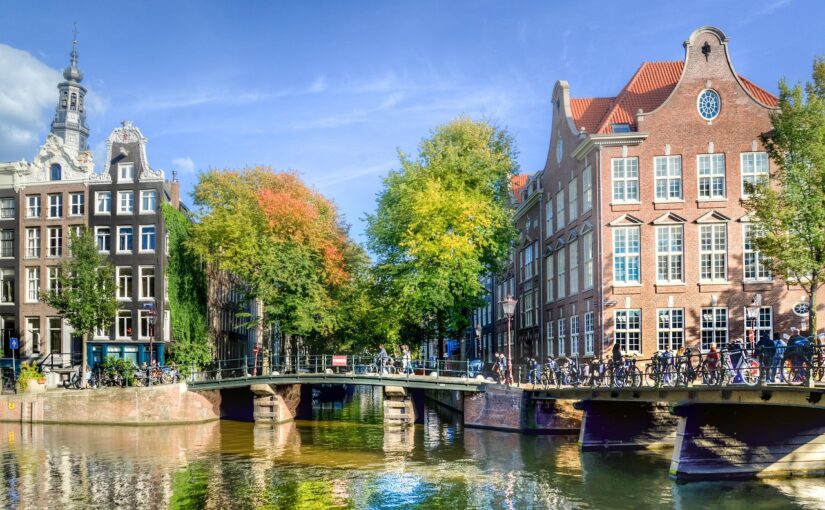
Several glasses later I lurch outside and head for the safety of my hotel. The Waldorf Astoria is the newest and possibly smartest hotel in town, an elegant conflation of six grand mansions on a seventeenth-century canal. These canals were built in Rembrandt’s lifetime to organise the city as a major trading capital with goods coming in by boat. Today Amsterdam’s inner rings of canals are a graceful sweep of urban civility, edged on one side by tall brick townhouses with red or green window shutters, and on the other by quiet waters where houseboats are moored beside bicycles. The Dutch pattern for urban living, in narrow terraced houses with gardens behind, spread to London during a century that ended with a Dutch king on the English throne.
The Waldorf is suitably historic inside. There’s a grand wooden staircase beneath white plaster scrollwork, marble floors leading to tall windows, and at the rear a garden with clipped lawns and a baroque summerhouse. My suite is in the loft, a vast space that would once have stored merchants’ goods.
I head downstairs to the Michelin-starred restaurant, where for dinner I struggle manfully through course after course of astonishing inventions. Exquisite confections are served on polished rocks or gleaming driftwood, frothing with foams, dripping with jus, entirely unrecognisable but definitely delicious. The Golden Age had nothing on this.
The best place in the world to see Rembrandts is the Rijksmuseum, and this is where I head next morning. Newly reopened after a 10-year refurbishment, it’s a lovely airy space now, where pride of place is given to the Golden Age artists. A wall of Vermeers portrays the everyday life in houses like Rembrandt’s, and some glorious Pieter de Hoochs show Amsterdam at the time – the newly built canals glimpsed from the homes of newly wealthy merchants. At the far end is Rembrandt’s grandest painting, The Night Watch, a dramatic commission from a city militia.
More interesting, for me, is a room of early Rembrandt oils, from the time when he was finding his style. It includes one of the first of the series of self-portraits that he made throughout his life and which tell his story as it showed in his face. Here the 22-year-old hopeful peers out from a mop of curly hair, his cheeks as yet unlined.
The life of Rembrandt van Rijn is one of the great dramas of European art. Born the son of a miller in 1606 in the newly independent Dutch Republic, he studied painting from the age of 14 and by his twenties was successful enough to move to Amsterdam and marry the cousin of his art dealer. But Saskia came from a grander family, none of whom attended the wedding. Later they claimed she was wasting her inheritance. Yet the happy couple prospered as his style became the height of fashion and wealthy townsfolk commissioned the series of portraits for which he is famous – luminous portrayals of character and spirit, increasingly perceptive as time went on, yet always compassionate. In his heyday, his self-portraits show a man in his prime, richly dressed and confident.
But his art went out of vogue and Saskia succumbed to – probably – tuberculosis. He drew her on her deathbed, heartbreaking sketches of loss. Three children had already died within weeks of their birth. He lost his savings on a trading venture that went wrong and had to sell the house. Declared bankrupt, he lost his license to sell paintings. In his later years, poor and obscure, he sold paintings through a front company set up by his son Titus. Then Titus died too. After Saskia, he had two relationships – both with servants – but one sued him for breach of promise and the other, Hendrickje, died in a year of plague.
Yet Rembrandt continued to paint and his latest works are the greatest: dark, brooding, loose-brushed, raw-emotioned, as though he no longer had time for the fineries of life and only sought the deeper truths of human experience. The final self-portraits show him aging magnificently.
And in these years, he was visited by one last great patron. The Grand Duke of Tuscany, a Medici prince on a European tour, took the trouble to visit him at home not once but twice. Cosimo de’ Medici is thought to have taken back with him to Italy one of those self-portraits, in a final act of homage.
I wander out of the Rijksmuseum, through a street of art galleries, to the area where Rembrandt lived in his twilight years. His last home no longer stands but it was in the Jordaan, a modest district that is quieter than the grand canals. Its brick-paved streets are host to traditional cafes, its cobbles are filled with bikes, and there’s a heron perched on the roof of a houseboat where I will stay tonight. Here I will be close to the water that brought the wealth into this city. I step onto the deck. Down a ladder there is one single cabin, a long room of polished planks and brass, its windows filled with glints of green water.
Next day beside the mooring I find the Tulip Museum, an intriguing place that houses an exhibition on the tulip mania that swept Holland in Rembrandt’s day. This was an investment bubble in then exotic flowers, when a single bulb could be worth as much as a townhouse, and it reflected the city’s wealth and style. Even today, Holland is famous for its flowers. Downstairs there’s a copy of a painting by Rembrandt: a tender portrait of Saskia, painted in the year of their marriage, with tulips in her hair.
Just across the canal from here is the Westerkerk, a handsome baroque church of weathered brick. There Rembrandt was buried in 1669, in a pauper’s grave whose whereabouts we do not know. Titus had died the year before and was buried here too, which may have broken his heart. On a pillar inside the church there’s a simple memorial plaque to the great painter, copied from a sign in his masterwork The Night Watch.
My final stop, for a little light relief, is the Five Flies. It’s a restaurant that is a monument to his era. If you want to step inside those boisterous paintings of Golden Age townsfolk enjoying a mighty fine meal, then this is the place. Its tiny, historic rooms are lined with Delft tiles and gilded leather, lit by carved fireplaces and flickering chandeliers, and served by an army of discreet waiters. The chairs carry brass plaques for celebrities who have eaten here, from Orson Welles to Jean Cocteau, Gary Cooper to Mick Jagger.
There is, of course, a Rembrandt Room. Its ceiling is dark with wooden beams, its walls are lined with shelves of leather-bound books. I slump into a seat, ready to be revived. And as the waiter pours a glass of chilled white wine, he points to the wall above my head. There, in an antique frame, is an etching that I recognise. He says it is an original. Nearly four centuries ago it was printed in that little house across this lovely city, from the copper plate now kept in the attic archive. It is Rembrandt’s portrait of Saskia, full of the love and promise of their youth.
I raise a glass to them both.