
“All of this was open prairie when Frank Lloyd Wright moved here in 1889,” says George, gazing at the rustling trees and Victorian villas of Oak Park, one of the leafiest suburbs in Chicago. “Back then his children played among dirt tracks and farms. So the houses he designed here were called the Prairie School. And they changed the face of America.”
We’re standing in the backyard of the Frank Lloyd Wright Home and Studio, the first house designed by the man who would become America’s most famous architect. And it’s buzzing with visitors, because this year marks the 150th anniversary of his birth – a moment to be celebrated with events at his houses, exhibitions in Chicago and New York, and a new Wright Trail across 200 miles of his beloved mid-West. So I’ve come here to see what the fuss is all about.
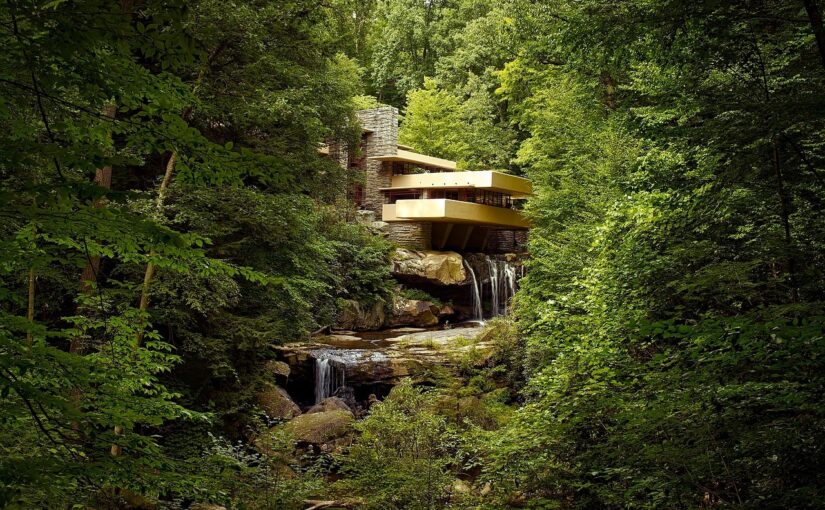
Oak Park isn’t his most famous neighbourhood. That would be Manhattan’s Upper East Side, where his Guggenheim Museum swirls an outrageous snail shell of concrete above the city streets, or Bear Run Stream in Pennsylvania, where his Fallingwater house floats like a beaver dam across a waterfall in the woods. To visit those places is to understand Wright’s extraordinary range and inventiveness as an architect, and his vision of ultra-modern buildings based on natural shapes and local landscapes. But here in Oak Park is where his story begins, and this area holds the greatest concentration of his buildings in the world.
“Wright built this place as a young man for his wife and children,” explains George, a tour guide at the Home, “but it already has the elements of his Prairie style.” We wander around a house that’s astonishing for 1889. Outside it might be clad in wooden shingles like a prairie cabin. But inside it’s all mod-cons –open-plan living rooms, geometric furniture, wraparound windows and a fitted wooden kitchen. It’s clearly been devised for rational, comfortable family living: a new design for a new way of life in a country that felt young.
I realise with a shock that my own childhood home in England was laid out just like this in 1968: front door hidden sideways in a porch, open-plan ground floor wrapped around a central rough-stone hearth, and sudden double-height rooms beneath swooping ceilings. How many of our homes, I wonder, have been built from Wright’s ideas in the years since his death in 1959?
As I leave, George hands me an audio-guide to the local area. In these few streets you can see some 30 buildings by Wright, commissioned by neighbours and friends in the 1890s and 1900s as his fame began to grow. There are six in his street alone – among them one of the finest Prairie homes, the Arthur Heurtley House of 1902. It’s wonderfully elegant, a low sweep of soft red brick beneath sheltering eaves, with a grand arched doorway and wide bands of Art Nouveau windows. It’s an early example of one of Wright’s guiding ideas: that strong vertical lines in a building anchor it to the ground and integrate it into the surroundings.
I take a lovely stroll in morning sunshine, spotting Wright houses among the family mansions of Oak Park, where children play on clipped lawns and rocking chairs wait on wooden porches. But up on East Avenue is a house where Wright’s local idyll ended. The Edwin Cheney House is a ramshackle bungalow he built for a friend – while falling in love with their wife.
Faced with social and professional disgrace, in 1909 Wright fled west, with his new love Mamah. He stopped in a remote part of the prairie 200 miles away, where in a quiet river valley his family had once been farmers. It must felt like sanctuary. And there in 1909 he started work on a second ideal home. He named it Taliesin, a Welsh word for ‘shining brow’, because it sat just under the brow of a sun-kissed hill: and that’s where today’s Wright Trail will lead me.
I clatter from Oak Park into Chicago on the famous elevated railway, known to generations as ‘the L’, and get out near Michigan Avenue. The concrete canyons of America’s second city soar 30 or 50 storeys overhead. It’s a very different vision of architecture from Wright’s natural forms – all steel and glass, corporate power, thrusting machismo. At the far end of Wabash Avenue I spot a row of giant letters on a heartless glass stump, the second tallest building in the city: they spell in capital letters ‘TRUMP’ and signify the property-developer President’s hotel.
In Wright’s day, this area was being rebuilt after a devastating fire in 1871 had razed the downtown. The building boom gave him his first job as a trainee architect. In the rush, local engineers invented the skyscraper – and the elevator that let you go so high. In fact, the first plate-glass covered skyscraper in the world was the Reliance Building on West Washington Street, built by the elevator magnate William Hale, and that’s where I’m heading for lunch.
Finished in 1895, the ground floor of this Art Nouveau skyscraper is now an elegant modern restaurant, Atwood, where I am due to meet Todd Palmer, Executive Director of the Chicago Architecture Biennial. He runs a city-wide festival of architecture, open to the public as well as the trade, which opens this year in September. “Architecture has always mattered in Chicago,” he says. “When you have no limits, here’s what you can do. A building can be a mile high, just like a black guy can be President. In fact, Barack Obama has just announced that he’s building his Presidential Library here, to regenerate the South Side. He used to talk about the audacity of hope: this will be the audacity of architecture.”
A great way to see the architecture – and audacity – of Chicago is to catch a boat tour down the Chicago River run by the Chicago Architecture Foundation. I catch it near the 1913 Wylie Tower, a riot of faux Renaissance buttresses and curlicues, and float through the city and its history right through the business district, where modern mirrored blocks perch on slender bases. At the end is America’s tallest building, the Willis Tower of 1974, whose 110 floors are topped with a viewing platform that overlooks four American states. Then we chug back to the dock, where a vast Apple store is being built beside the renovated waterfront. “It’s by Norman Foster,” says the boat guide. “The horizontal canopy of the roof is a nod to the Prairie Style, of which we have so much in Chicago.”
Closer to Frank Lloyd Wright’s era is my hotel, the classic Palmer House of 1873. Walking up the grand marble stair to the central lobby, I sense the opulence and optimism of those days, when Chicago boasted the world’s biggest meatyards, busiest railway and largest post office, when this was the boom-town gateway to the Great Lakes and the American West, and when America was creating its modern self and emerging as the world’s greatest economy.
That’s what paid for the architecture. And this is where the new rich came – to the hotel’s chandeliered bar with its soaring columns and frescoed ceiling, and its ballroom lined with satin swags and glittering mirrors. This was known as the Gilded Age and the gold is all around me.
I wander out for dinner at another icon of the era, the Chicago Athletic Association. This Victorian Gothic skyscraper of 1893 has recently been converted into a fabulously preppy hang-out with wood-panelled saloons, a frat-like snooker bar and the Cherry Circle Room. I’m heading for the latter, a mellow eaterie that has won the James Beard Award, America’s top culinary prize. Inside it’s all leather banquettes and Art Deco lights, with a soft jazz soundtrack and a fine line in Chateaubriand steaks. I tuck in.
Next morning I set out on the Wright Trail, in a hire car along the dazzling shore of Lake Michigan. Lake Shore Drive has marinas on one side and glittering condos on the other. I pause at the Emil Bach House in Rogers Park, a 1915 Wright house where you can stay. It’s a modest Art Deco-style place with all the hallmarks of Wright: open-plan living and dining rooms, circling around a rough-cast central hearth and lit by horizontal bands of windows. From the garden there’s a glimpse of the lake just a block away.
Then it’s onto the Interstate highway, dodging unfeasibly large cargo trucks which all seem to be painted red. I head for Racine, a once-industrial town just across the state line in Wisconsin. Here Wright built what he hoped would be an ideal blueprint for industry: the Johnson wax company’s headquarters. “The finest office building in the world,” was how he described it, “as inspiring a place to work in as any cathedral ever was to worship in.”
Even today, the place is visionary. I walk in past rippling pools to a low brick building lit by massive windows, where a lofty open-plan workspace is furnished with ergonomic steel desks and chairs. Fifty tapering columns that look like giant lily stems support a vast glass ceiling to let in more light. It was the first building in the USA to have air conditioning. This is a different vision for corporate existence from today’s harsh geometry back in Chicago. And here, as long ago as 1939, Wright set standards for working conditions that have hardly been bettered. Today it’s still used by 300 lucky office staff.
But most of the industry has gone from Racine, and as I drive the backstreets I see sagging clapboard houses and rusty cars in what once were neat neighbourhoods. The glory days have long gone, and in November’s election Wisconsin swung from Democrat to Republican. As I cruise on, I see an isolated landscape of scattered farmlands and wooden villages, wreckage from another era floating on the rich black earth of the open prairie. The gilded age has clearly passed.
I chug on to Milwaukee, where in a shabby suburb Wright once built his vision of affordable housing for all. “Welcome to the American System Built Houses,” smiles Mike Lilek, trustee of the Wright In Wisconsin charity, showing me around a row of six modest houses on West Burnham Street.
“To enjoy a Wright house you have to walk through it,” he says. “This one has 33 windows, to connect you to the outdoors. It has serene colours. Mr Wright said ‘For your colours, go to the woods, not to the store.’ He believed in connecting with nature.” Mike grins. “Sixty per cent of the people I take around here say ‘I could live here.’
“Wright spent more time on this project than any other, because he thought these could be mass-produced cheaply and built all over the country. He thought ordinary people should have an architect-designed home. And he wanted to design something American, fiercely American, something you could say ‘This is ours.’ “
The houses are modest but well proportioned, with an Art Deco serenity and plenty of windows. Some are still being refurbished, and Mike asks me what is the strange white surface on the exterior of the walls. He can’t find anyone in the States to repair it. “Pebbledash,” I smile, “must have been one of his experiments.”
I thank Mike and head further west, following the Wright Trail signposts to Madison, the capital of Wisconsin. It’s a handsome town between lakes and woods, with a neo-classical capitol on the hill as you drive in. Wright was brought up here in the 1870s, 40 years after it was the frontier of the West. In the 1940s he gave back, with a church for the faith of his fathers in a style that echoes those prairie pioneers. The Unitarian Meeting House has a roof that rises like the canopy of a covered waggon, and a base shaped like the blades of a plough cutting into the lawn around it.
I park and go inside. It’s like the tardis – a low-ceilinged entrance and then a
spectacular chapel, soaring from the low lobby to a 60-foot high roof, walled with sheer glass, a spectacular space for worship where worshippers look straight into sunlight and nature, which Wright saw as symbols of the divine.
Rather less divine was the 20-year struggle Wright had with local politicians to approve plans for his other great Madison building, the Monona Terrace. It was never built in his lifetime, but one of his trainees, Antony Puttnam, completed it in 1997. Today it sits on the shore of pretty Lake Monona, a low curve of white concrete hiding dramatic public spaces for concerts, conventions and parties. The walls are hung with 1950s photos of the master himself, taken by his official photographer Pedro Guerrero. It’s good to finally catch a glimpse of the man. Here he is in his trademark Western hat and suit, talking with trainees and clients. His face is handsome and thoughtful, but lined with the cares of three marriages and constant money worries.
To get a stronger sense of him, I trundle on to Taliesin, the house among hills that he built and rebuilt from 1911 for the rest of his life. It sits in the wonderfully named Driftless Valley, a lovely region of ridges and forests where deer leap onto the road beside my car. True to Wright’s naturalistic beliefs, the house is a low complex of roofs and balconies just below the brow of a hill, slipped into the landscape. Here he gathered a community of students and collaborators, founded an architecture school that still runs, and rebuilt the village school for his teacher aunts. Taliesin became his kingdom and laboratory, continually modified and expanded as he tried out new ideas that fed into his masterworks. And these days it’s open to the public.
I’m taken around by Ryan Hewson, who trained here as an architect and now works as a curator. “Learning here was wonderful,” he says as we peek into the architecture school with its drawing boards and monastic bedrooms. “This place was his sketchbook, where he could push ideas as far as he liked. But we were lucky – in Mr Wright’s day students had to work on the farm and help build the house as well.”
The house is equally wondrous: a maze of dreamy rooms with wide windows looking onto forests, fields and the Wisconsin River. It’s hung with a fabulous collection of Japanese prints, which Wright collected and dealt in. The Japanese influence on his work is evident in the post-and-beam construction of his studio, and in fact he had worked in Tokyo on a hotel project in the 1910s.
In the old drafting room I meet the last of Wright’s original community. Antony Puttnam is a white-haired architect who trained with Wright and completed the Monona Terrace after his mentor’s death. He says hello in a slow, mid-Western drawl and tells me how he came here.
“In 1953 I walked into the living room here as a curious student and thought – this is the place.” He muses as though still surprised. “It effects a lot of people like that. Just last Spring I took some architects around and half of them wept. So I asked Mr Wright if I could stay.
“His standard was – if it isn’t beautiful, don’t do it. He was witty and charming, very light on his feet when talking to people, but determined. He expected things. Some of the work here was a little improvised, but it’s still standing. He was always changing and experimenting with ideas. The house was almost a maquette for seeing what could be done. It’s a statement of alternate reality.”
Wright set his alternate reality in a place he had discovered as a boy. The Driftless Valley was settled by his Welsh immigrant family in 1858, and he was sent as a teenager to spend summers on his uncle’s farm. “The valley taught me everything,” he said, and his love of nature and landscape started there.
From his final living room in Taliesin, you can see their old farm across the valley. I drive over. Just below a hill is the Aldebaran farmhouse of 1861, shingled like Oak Park and sheltered by deep roofs. Inside there’s a rough central fireplace circled with living rooms. The big windows look onto grass and trees. These things became Wright hallmarks. Were they really aesthetics or memories? Was this the original Prairie House? I stand on the porch and stare from his childhood to his future across a meadow of softly waving grass and understand why he came home.
Just across the country road from the farm I see the spire of a chapel. It’s the Wright family resting-place and the first building he ever worked on. As a young unknown, his family offered him work on designing the roof. I walk through the rusty gate.
The chapel is a square of American Gothic, wood-shingled walls and a simple spire, in a copse of trees beside a stream. It’s like stepping back into the frontier days, before the boom and bust of what America became. Around it under yew trees lie the graves of generations of his ancestors, back to 1870.
Here are his mother and the teacher aunts, the farming uncle, and his lover Mamah. And then in a circle of pebbles is his own grave from 1959, topped with a boulder of granite. Beside him are his children, many of his collaborators, and the photographer Pedro Guerrero.
In this cradle of the settler generation, I sense Frank Lloyd Wright’s life spanning the years of American greatness, reaching from them into the future with all his optimism and patriotism, his belief in community and nature. And I wonder whether we shall see giants like him again.
As I turn to leave, an eagle soars into the prairie sky.